


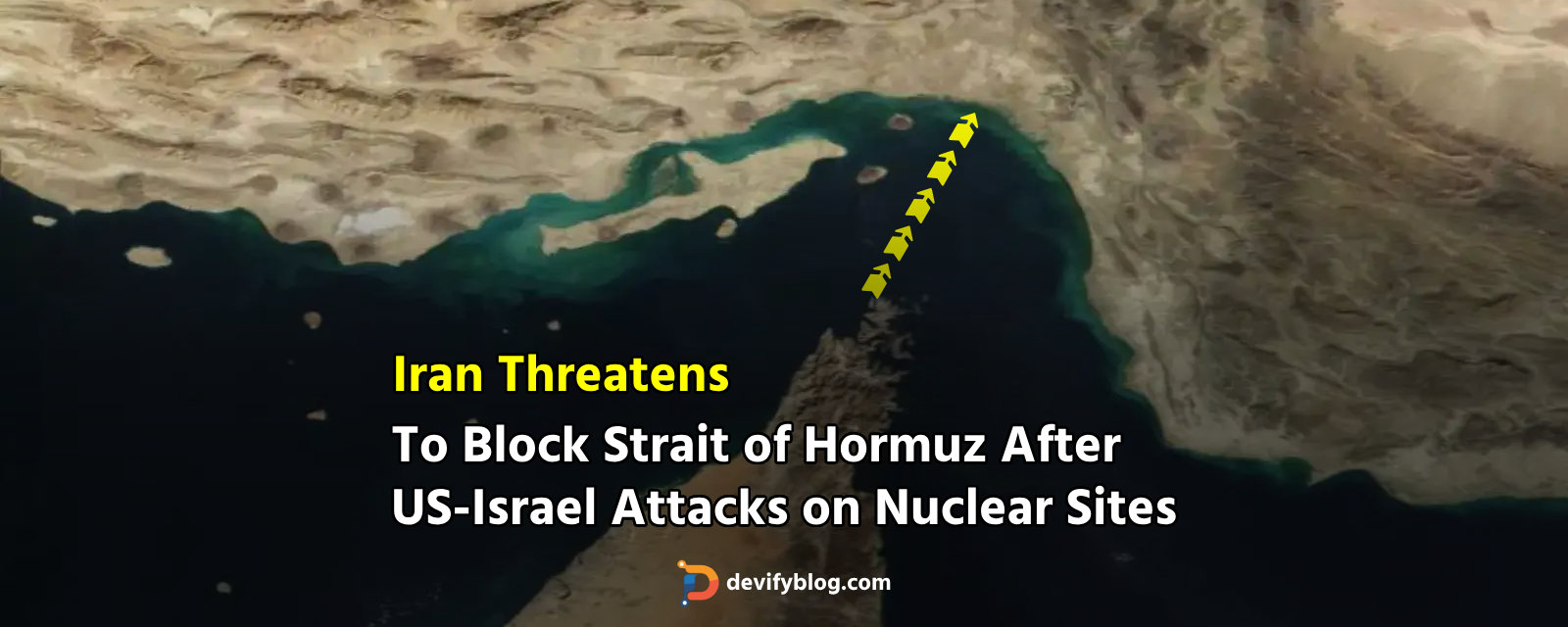
Iran has made its clearest threat in years to close the Strait of Hormuz, a vital maritime chokepoint for the global energy supply. This announcement comes after a significant intensification of hostilities, which includes U.S. airstrikes on Iranian nuclear sites, Israeli drone assaults, and Iran’s missile reprisals.
Rear Admiral Alireza Tangsiri, a senior commander in Iran's Islamic Revolutionary Guard Corps Navy (IRGCN), declared on state media that “the Strait of Hormuz is fully controlled by the Islamic Republic and will be blocked if our interests are further threatened.”
Iran has characterized its threat to close the Strait of Hormuz as part of a “defensive doctrine” in response to recent coordinated U.S.-Israel strikes on critical Iranian nuclear sites at Natanz, Fordow, and Parchin. The Islamic Revolutionary Guard Corps (IRGC) has characterized this action as a strategic necessity for protecting national interests and sovereignty.

A strongly worded statement from Iran’s Supreme National Security Council declared:
"Should aggression escalate, we will not hesitate to use our geographical leverage to protect national sovereignty and dignity. The Strait of Hormuz will become a strategic weapon if necessary."
Iran condemned the airstrikes as a breach of international law and a blatant act of war, cautioning that ongoing aggression would lead to grave repercussions at both regional and global levels.
Iran is militarily well-equipped to carry out its threat. For a long time, it has employed various asymmetric naval capabilities tailored to interrupt maritime traffic in the Strait of Hormuz. These consist of:
- Anti-ship ballistic missiles with growing range and accuracy.
- Fast-attack craft equipped with rockets and torpedoes.
- Armed drones capable of targeting vessels and oil platforms.
- Naval mines to block or damage tankers.
U.S. intelligence sources have released satellite imagery showing a significant rise in IRGC naval mobilization around Bandar Abbas and Qeshm Island, indicating an increase in operational readiness.
The message from Iran is unequivocal: if it faces further provocation, it will utilize its geographic dominance over the globe’s essential oil chokepoint as a weapon in its strategic considerations.
Global Reactions and Strategic Implications
➵ United States
- The Pentagon condemned Iran's threat and responded by deploying additional destroyers and surveillance aircraft to the Gulf region.
- Commander of CENTCOM, Gen. Erik Kurilla, stated: “Freedom of navigation cannot be negotiated. Any effort to shut down the Strait will elicit a suitable military reaction.
➵ Oil Markets
- Oil prices skyrocketed, with Brent crude jumping 8.6% and surpassing $100 per barrel for the first time in more than a year.
- Nations reliant on energy, such as India, Japan, and South Korea, expressed concern about possible supply interruptions.
➵ Gulf Cooperation Council (GCC)
- The UAE, Saudi Arabia, and Bahrain released a joint statement calling for de-escalation and the preservation of maritime stability.
- Nevertheless, military preparedness in the Gulf is at a heightened state of alert, with increased security measures being implemented at the UAE’s Jebel Ali Port and Saudi oil terminals.
➵ International Community
- The Security Council of the United Nations (UNSC) convened an urgent meeting behind closed doors.
- Russia and China urged for calm while stressing Iran's right to protect its territorial integrity.
- With EU foreign policy chief Josep Borrell offering to mediate, the European Union expressed serious concern.
Conclusion
Once again, the Strait of Hormuz is central to a potential worldwide crisis. Although Iran has not yet physically obstructed the waterway, its threat is significant. Any attempt to implement this would violate boundaries established by the U.S. and its allies, endangering not only regional warfare but also a worldwide economic crisis.
It is said that diplomatic backchannels are functioning, yet as missile strikes, sanctions, naval deployments, and nuclear escalation loom, the world observes with trepidation as the Gulf hangs precariously on the brink of a perilous new phase.
➽ Early Sunday, U.S. Strikes on Iranian Nuclear Sites ... click here...
Login to leave a comment.