


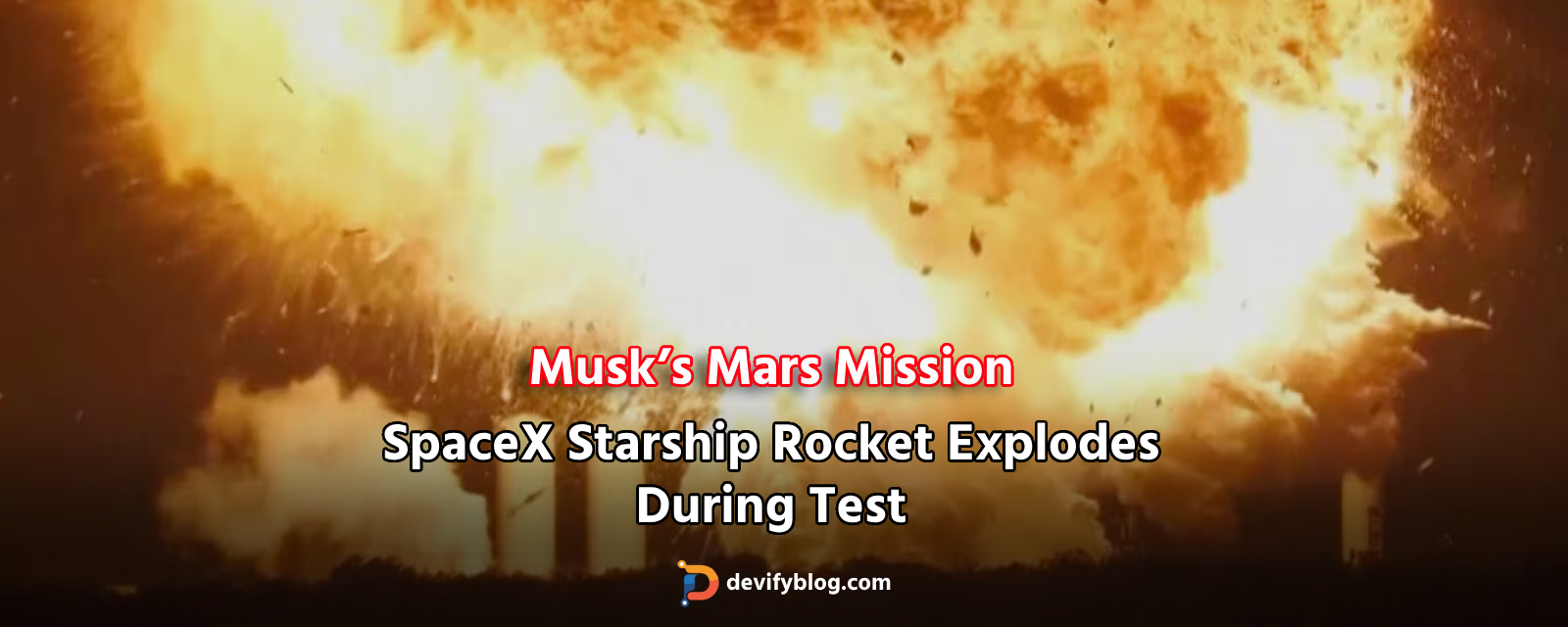
According to SpaceX's social media post, on June 18 at approximately 11 p.m. CDT, the Starship prototype, Ship 36, exploded during a static fire test at the Massey's Test Site next to Starbase (Brownsville, Texas).

Holding it down on the test stand, the rocket ignited and then exploded in at least two consecutive bursts, lighting up the night sky and scattering debris throughout the site.
Elon Musk, the CEO of SpaceX, stated that the cause seems to be a nitrogen composite-overwrapped pressure vessel (COPV) failure in the payload bay, which would be the first time that design has failed. Although the corporation described the incident as a "major anomaly," it confirmed that no employees were hurt and that safety procedures were followed, enforcing safety zones and posing no threat to the local people.
After three previous flight failures in 2025, this is the fourth Starship loss:
Flight 9 (May 27): Arrived in space, but broke apart and plummeted on descent.
Flight 8 (March 6): Over the Caribbean/Turks & Caicos, the upper stage split up due to an engine failure and lost control.
Flight 7 (January 16): Regional airspace was closed due to debris, and aft flames were started by an engine leak or failure, which resulted in breakup.
Notwithstanding these obstacles, SpaceX continues to follow the maxim "fail fast, learn faster," viewing each setback as an opportunity to refine the design. However, the Massey's test stand is severely damaged by this explosion, forcing it offline for repairs. This will probably delay the next static fire test, which will delay the preparations for the 10th orbital test flight. This will also impact the timelines for deep-space aspirations, such as Mars and lunar missions.
In addition to being a key component of SpaceX's long-term strategy to make space travel reusable and economically viable on a large scale, Musk envisions human flights to the Moon and Mars by 2026–2027. Delays are exacerbated by facility damage, making this the fourth significant failure of the year. Every failure provides information that is essential to enhancing reliability, but if issues continue beyond late 2025, Mars ambition timeframes may change significantly.
In conclusion, SpaceX is still dedicated to iterative testing even if this explosion is a significant setback that will cause additional delays and damage to the infrastructure. Considering that Starship has already seen more than a dozen significant setbacks, these developments are internally viewed as steps in the direction of creating a workable vehicle that can travel to Mars.
Login to leave a comment.