


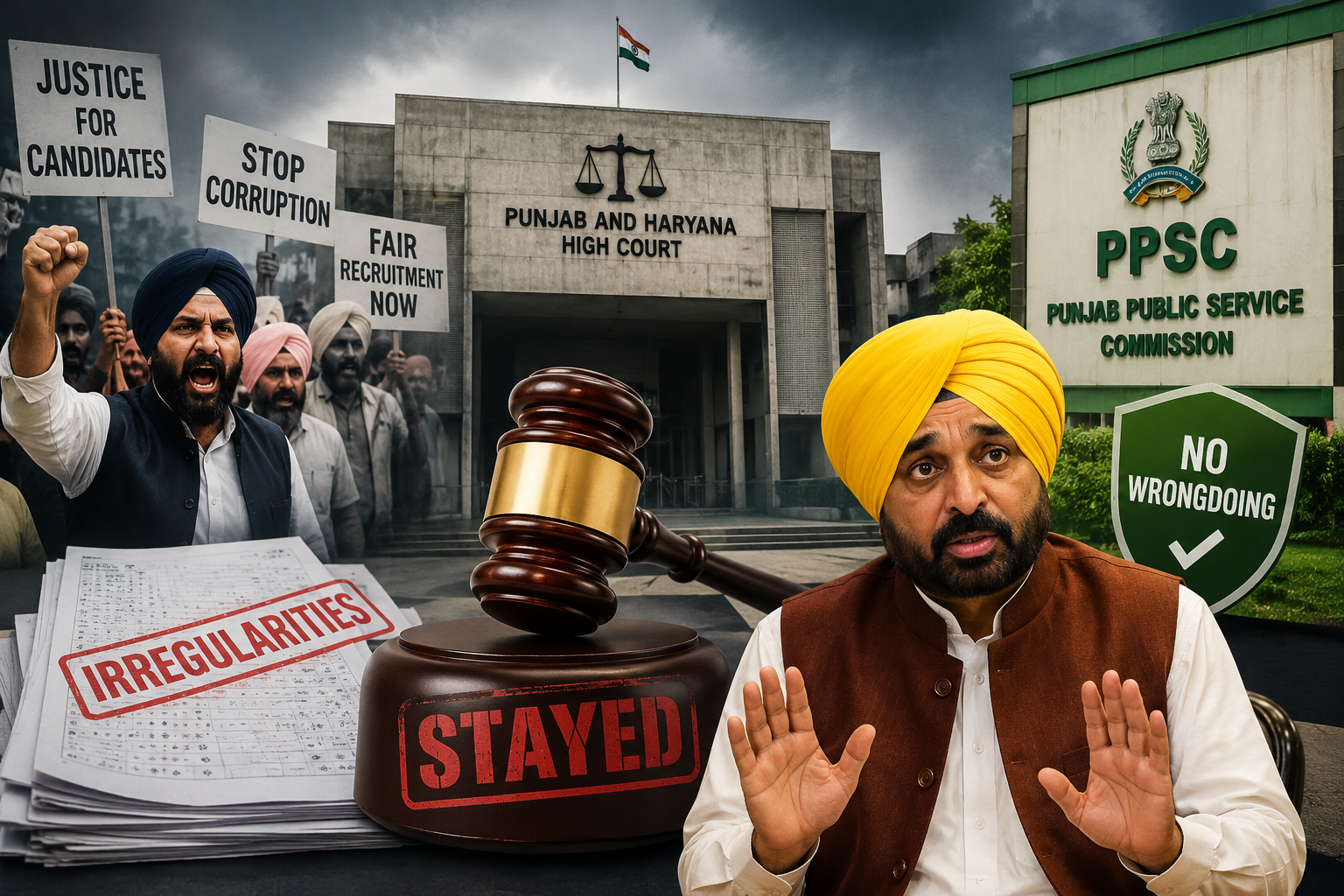
The Punjab and Haryana High Court on Thursday, 19 November 2026, stayed the recruitment process for the Punjab Civil Services (PCS) and Allied Services, which is run by the Punjab Public Service Commission (PPSC). The interim order came on petitions by candidates who allege irregularities in the selection process and who want an independent probe.
The court issued notices to the respondents and fixed 16 December as the next date of hearing. The stay has set off a fresh round of political attacks on the AAP government led by Chief Minister Bhagwant Mann. The BJP, the Congress and the Shiromani Akali Dal (SAD) have all demanded action, while the PPSC and the government have rejected the allegations.
The allegations have not been proved. The High Court has not made any finding on them so far, and its detailed order was not available in the reports reviewed for this article. This report covers what the petitions claim, what the PPSC says, who has reacted and how, and what happens next for the aspirants.
What the High Court Ordered
The order was passed by Justice Sandeep Moudgil while hearing petitions that challenge the recruitment started through an advertisement dated 3 January 2025 and the Mains result declared on 4 November, in which 751 candidates were shortlisted for interviews. The court stayed further proceedings in the recruitment and issued notices.
As per IANS, with the process stayed, further steps are likely to remain on hold until the next hearing. The Tribune reported that the petitioners also asked for the complete recruitment record to be sealed or summoned by the court. One report noted that the exact scope of the relief will become clear only once the written order is available.
The number of posts differs slightly between reports. The Tribune said 751 candidates were provisionally shortlisted against 331 advertised vacancies. Another outlet said the recruitment covers 322 posts. Check the PPSC advertisement before you quote a figure.
What the Petitioners Allege
The petitions raise several objections. The best known is about roll numbers, but it is not the only one.
Consecutive roll numbers. The petitioners say 26 clusters of three or more consecutive roll numbers appear in the list of shortlisted candidates, accounting for 86 candidates. They point to two sequences of six consecutive numbers, 11004 to 11009 and 12159 to 12164. According to IANS, they also claim to have identified another 118 clusters of consecutive roll numbers, involving 270 candidates.
Concentration at centres. Aspirants have said that some examination rooms recorded 10 to 11 selections each, and that one centre accounted for nearly a quarter of all qualifiers.
Change in the Punjabi condition. The petitions say the original advertisement made passing Matriculation with Punjabi mandatory, and that this condition was diluted midway. They also question age criteria, multiple application forms, extensions of application deadlines and the verification of reserved-category candidates.
Conduct of the exam. The petitioners claim that question-paper packets at some centres were found unsealed or damaged, that classrooms were changed at one centre, and that answer sheets were handled and evaluated irregularly.
Transparency. The aspirants have questioned the absence of category-wise details in the result, and the fact that different roll numbers were given for the Preliminary and Mains examinations, which they say made scrutiny harder.
They have asked the court to quash the recruitment process and to order an inquiry by the Central Bureau of Investigation (CBI) or a special investigation team (SIT).
What the PPSC and the Government Say
The Commission and the government responded within two days of the result, and their position has not changed.
The Tribune reported that the AAP government dismissed the allegations as politically motivated, while the PPSC described them as a misinterpretation of statistical data. The PPSC gave figures to support this.
- 3,959 candidates appeared at 12 examination centres in Patiala. Of these, 751 were shortlisted, which is a success rate of about 19 per cent.
- The highest number of qualifiers from a single centre was 106, which is 14.1 per cent of the total. That centre had 496 candidates, the second-highest among the 12.
- Classroom-wise variation and consecutive roll numbers were statistically plausible, and similar patterns appeared in the 2018 and 2020 shortlists.
- No absent candidate was declared qualified, and biometric and manual attendance systems were used at all centres.
- The centres were located around Patiala for administrative, logistical and security reasons, and shortlisting was done category-wise as per the rules and the advertisement.
There is a gap between the two sides on one number that readers should note. Aspirants said one centre accounted for nearly a quarter of qualifiers, while the PPSC’s figure for its largest centre is 14.1 per cent. The reports reviewed do not explain the difference, and it may be a matter of how the centres or categories were counted. The court may need to look at the underlying data.
The PPSC chairman also pointed out that consecutive-row selections occurred in earlier recruitments. The candidates answered that this year’s exam had more vacancies and more Mains candidates, which in their view should have produced wider scattering of roll numbers.
Political Reactions: BJP, Congress and SAD
The reactions split along the usual lines in Punjab, where assembly elections are due in early 2027.
BJP. National spokesperson Pradeep Bhandari alleged on 5 November that a paper leak mafia was operating under the AAP leadership, and said candidates not registered for the exam had been selected. The PPSC says no absent candidate was declared qualified. State president Kewal Singh Dhillon rejected the PPSC’s clarification as a self-clean chit and asked for the CBI to take over this case and other recruitment controversies under the supervision of the High Court. Former state president Sunil Jakhar called the exam hijacked, demanded a CBI probe and a stay on interviews, and said the BJP would order an inquiry if it formed the government. After the stay, BJP spokesperson Sudhanshu Trivedi alleged that some selectees were linked to families of officials close to the AAP government. That claim is unverified, and no court has ruled on it.
Congress. Punjab Congress chief Pargat Singh questioned the results and asked the Chief Minister for answers. After the stay, Punjab Congress in-charge Sachin Pilot said the stay showed there were irregularities and that the government had failed to run the exam fairly and transparently.
SAD. SAD president Sukhbir Badal sought a CBI probe, cancellation of the selection process and re-examination. He alleged that many successful candidates had links with senior bureaucrats, police officers and AAP functionaries, and said the PPSC had released only roll numbers, not names. Party leader Arshdeep Singh Kler welcomed the stay and said the SAD had also filed a petition. A delegation of students met Governor Gulab Chand Kataria and demanded a CBI probe.
These are claims by opposition parties. The AAP has called the allegations politically motivated, and the court has not yet ruled on the merits.
Why Roll Number Clusters Matter
The central argument needs some explanation, because it is often misunderstood.
In a large exam, roll numbers are normally given in order of application or by some set rule, and candidates sit in rooms according to those numbers. If the shortlist shows many runs of consecutive roll numbers, petitioners argue that this could point to candidates seated together, and they ask whether it points to copying, leaking of papers or favoured allocation of seats. The petitioners cite earlier court rulings that say such clustering should be examined early.
The PPSC’s counter is statistical. With 3,959 candidates and about 19 per cent qualifying, it says some runs of consecutive numbers will occur by chance, as they did in 2018 and 2020.
Both arguments can sound convincing, which is why the court may want the full record. Courts have in other cases asked for the roll number allotment, seating plans and evaluation records to test claims of this kind. Whether this court will do so is not known yet.
What It Means for the Aspirants
For candidates, the stay brings uncertainty more than any outcome.
- The 751 shortlisted candidates cannot move to the next stage while the stay lasts. The reports reviewed do not give interview dates.
- Candidates who were not shortlisted and who think the process was unfair may wait for the 16 December hearing.
- A final decision could take months. The court may uphold the process, order a probe, or direct a fresh shortlisting, and each path leads to a different timeline.
Aspirants should rely only on the PPSC website and official notices for dates and instructions, and not on social media posts.
What Is a Stay and What Happens Next
A stay is a temporary order that pauses a process. It does not decide who is right. The High Court has paused the recruitment so that the petitions can be heard without the process moving ahead and creating facts on the ground.
Three things could happen next.
- The PPSC and the state file replies. The respondents have been given notice, and their replies will show how they answer the specific points on roll numbers and exam conduct.
- The court examines the record. It may call for the answer sheets, seating plans and evaluation records, or direct that they be preserved.
- The court decides on an independent probe. The petitioners want a CBI or SIT probe. Whether the court orders one, and who would conduct it, will be a key question on 16 December.
What to Watch Next in the PCS Case
The next hearing is on 16 December. Before that, watch for the written order of the stay, any reply from the PPSC in court, and any statement from the state government. Also watch whether any party or the aspirants approach the Governor or the CBI directly, and whether the PPSC publishes more data, such as category-wise results.
Frequently Asked Questions on the Punjab PCS Recruitment Stay
What did the High Court order?
The Punjab and Haryana High Court stayed the PCS and Allied Services recruitment process conducted by the PPSC on 19 November 2026, and issued notices to the respondents.
When is the next hearing?
The next hearing is on 16 December 2026.
Why did the candidates go to court?
They allege irregularities, including clusters of consecutive roll numbers among the 751 shortlisted candidates, changes to the Punjabi eligibility condition, and problems in the conduct of the exam. They want a CBI or SIT probe.
What does the PPSC say?
The PPSC says the allegations misread statistical data, that similar patterns occurred in 2018 and 2020, that no absent candidate was declared qualified, and that attendance was recorded by biometric and manual systems.
How many candidates were shortlisted?
A total of 751 candidates were shortlisted from 3,959 who appeared at 12 centres in Patiala.
How many posts are there?
The Tribune reported 331 advertised vacancies. Another outlet reported 322 posts. Check the official advertisement.
Who has demanded a CBI probe?
The BJP, SAD and aspirants have demanded one, and the Congress has also questioned the results. The AAP government has called the allegations politically motivated.
Are the allegations proved?
No. The court has not made any finding on the merits.
Login to leave a comment.