


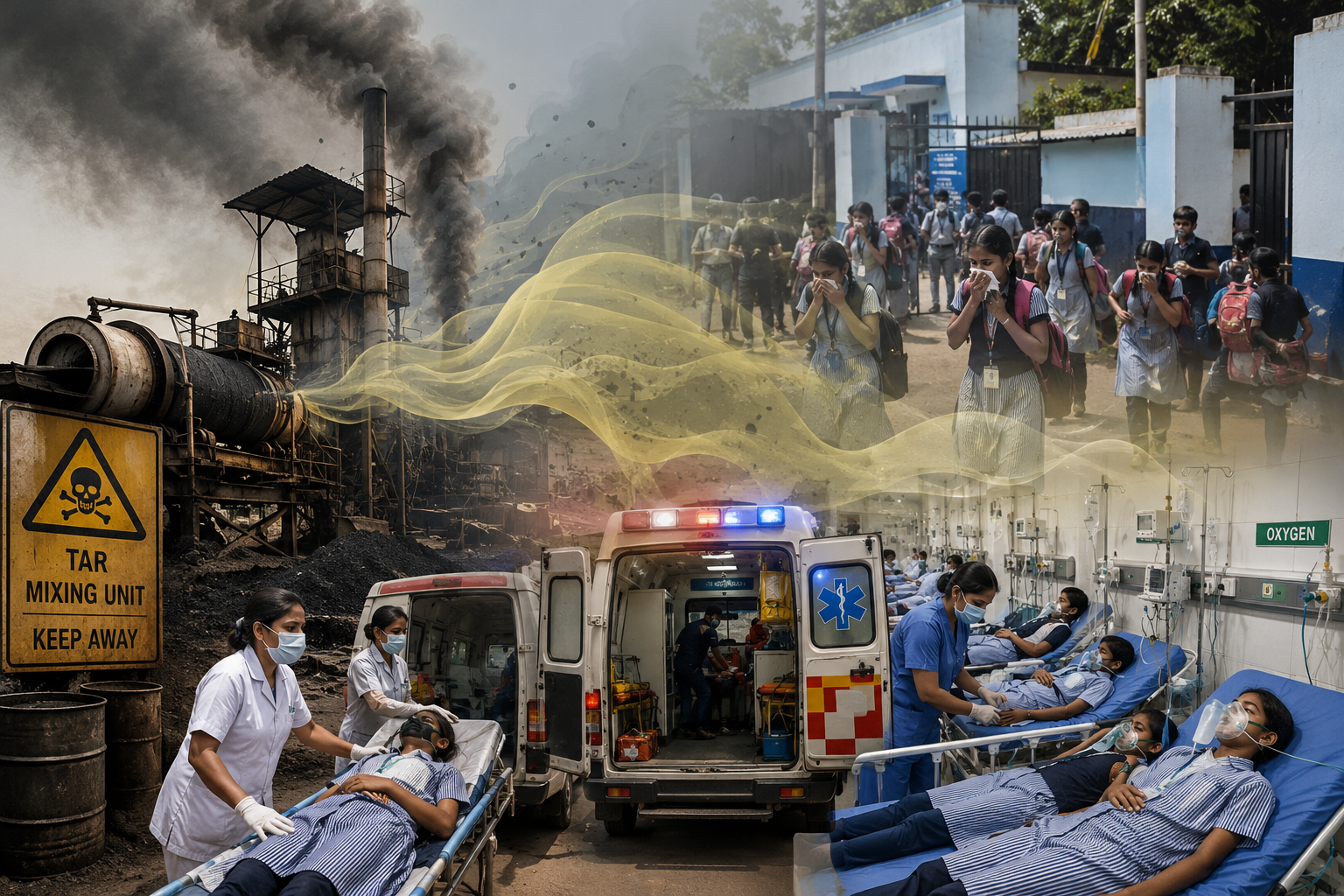
More than 50 students of a private school at Kottiyam in Kollam district, Kerala (Keralam), were taken to hospital on Wednesday, 18 November 2026, after complaining of nausea, breathing difficulties and uneasiness. Parents and residents blame fumes from a tar-mixing unit that operates close to the school. Police said all the children were stable and none had a major health problem.
The plant had been shut earlier after complaints from residents, and it had restarted after the High Court vacated a stay on its functioning. It was closed again on Wednesday after the incident. The State Human Rights Commission has opened a case on its own and asked for a report within 15 days.
This report covers what happened at the school, how many students were affected, the history of the plant, the reaction of parents and political groups, the inquiry ordered by the rights panel, and the questions that are still open.
What Happened at the Kottiyam School on 18 November
As per PTI, the students, studying in classes up to Plus Two, began to complain of nausea, breathing trouble and uneasiness at the private school in Kottiyam. The school has been named in reports as Auxilium ISC School. A senior police official told the agency that many of the children complained of nausea and difficulty in breathing.
Residents and parents said that thick smoke started entering the school premises soon after the tar-mixing plant resumed operations earlier in the day. According to a report in The Hindu, the students had severe breathing difficulties, nausea and vomiting. The school authorities evacuated the affected classrooms, and the episode caused panic among parents.
Around eight ambulances were used to move the students to a nearby hospital, according to local authorities. Police and panchayat officials stepped in after the incident.
How Many Students Were Affected?
The number changed through the day, which is common in fast-moving incidents. A careful report should say which figure comes from whom.
- More than 30: early local reports in Malayalam media in the afternoon.
- More than 40: another Malayalam report, which said the children were admitted to a private hospital.
- More than 50: several outlets, including Deccan Chronicle and The Daily Jagran.
- 55 to 60: local representatives and residents, as reported by PTI.
- 62: the figure given by police, as reported by PTI.
For your headline, the safest wording is more than 50 students. If you want an exact figure, use 62 and attribute it to police.
Symptoms and Condition of the Students
The students complained of nausea, vomiting, itching, uneasiness and difficulty in breathing, according to the reports. The senior police official quoted by PTI said none of the children had any major health issue and all were stable at the time.
There has been no public statement from the hospital in the reports reviewed here about test results, treatment given or when the students were discharged. That detail will matter, and it is worth checking with the hospital or the district health officials before you publish a follow-up.
The Tar-Mixing Unit: Earlier Closure, Court Order and Stop Memo
The history of the plant is a large part of the story.
According to police, the unit had earlier been closed after residents complained about pollution. It resumed operations after the High Court vacated a stay on its functioning, following a plea from the plant’s management. Residents also said the panchayat authorities had earlier issued a stop memo against the plant, and that it restarted after obtaining court permission.
Parents and residents told reporters that the students began to feel unwell only after the plant restarted. The police official said the unit was shut again after Wednesday’s incident.
The order of events, as reported, is therefore this: complaints from residents, a stop memo, a stay on operations, the stay being vacated by the High Court, the plant restarting, and then the students falling ill.
Protests by Parents and Residents
The incident led to protests. Parents and local residents demanded that the plant be closed permanently. They alleged violations of environmental norms.
Activists of the Democratic Youth Federation of India (DYFI), the youth wing of the CPI(M), laid siege to a service road in Kottiyam. They protested what they described as the failure of the district collector or any other senior official to visit the site. The CPI(M) leads the state government, which gives the protest a political edge that reporters should note.
Human Rights Commission Orders an Inquiry
Later on Wednesday, the Kerala State Human Rights Commission registered a case on its own, based on media reports, according to an official statement. It ordered an inquiry into the allegations that the students fell ill after inhaling smoke from the tar-mixing plant.
Commission member V Geetha directed three officials to investigate and submit a report within 15 days: the district collector, the environmental engineer of the Pollution Control Board, and the panchayat secretary.
That gives a rough timeline. A report is due by early December. Its findings, along with any air quality or emission data, will be the first official account of what happened.
What Is Still Not Known About the Cause
This is where a news report needs care. The cause of the students’ symptoms has not been independently established, according to the reports. Residents and parents have linked the incident to the plant, and the police official described the pollution as alleged. That is a claim, not a finding.
Several questions are open.
- Did the Pollution Control Board take air samples on 18 November, and what do they show?
- Was the plant operating with valid consent and within the conditions set for it?
- Which activity at the plant on that day released the smoke that residents described?
- Were there other possible sources of the symptoms, such as something inside the school?
- What did the doctors find, and were any students kept for observation?
The rights commission’s inquiry and any pollution board report should answer some of these. Until then, it is better to write that the students fell ill allegedly because of the plant than to say the plant caused it.
How Tar-Mixing Plants Can Affect Nearby Air
This section is general background and not a finding about the Kottiyam unit.
A tar-mixing plant, often called a hot-mix plant, heats bitumen and stone aggregate to prepare the material used to surface roads. The process involves burning fuel and heating bitumen, and it can release smoke, fine particles, odour and gases. People near such plants often report burning in the eyes, a scratchy throat, coughing, nausea and headaches, particularly when the wind carries the smoke towards them.
How much a plant affects its neighbours depends on how it is built and run. Pollution control equipment, chimney height, the fuel used and the distance from homes and schools all matter, and so does the direction of the wind on a given day. Plants need consent from the state pollution control board, and consent conditions usually spell out what the plant must do to limit emissions. The exact conditions for this unit were not available in the reports reviewed.
What Schools and Authorities Should Check
The episode raises practical questions for schools that sit near industrial units.
- Consent and conditions. Check whether any unit near the school has valid consent and whether it follows the conditions on emissions and distance.
- Monitoring. Ask the pollution control board for air quality data around the school, especially on days when the unit runs.
- Emergency plan. Schools should have a simple plan to evacuate classrooms and reach the nearest hospital quickly. In Kottiyam, the quick use of ambulances helped.
- Communication with parents. A clear and fast message to parents reduces panic and rumours.
- Complaint record. Residents and parents should keep a dated record of complaints, photos and videos of smoke, and the responses they receive.
What Parents Can Do Now
This is general guidance, not medical advice. For any child with symptoms, a doctor’s opinion is the right step.
- Take a child with breathing trouble, persistent cough, vomiting or chest discomfort to a doctor without delay.
- Move children away from visible smoke or strong fumes, and into fresh air where it is safe.
- Note the time when symptoms started and what the child was doing, because doctors and investigators will ask.
- Share your complaint in writing with the school, the panchayat and the Pollution Control Board, and keep copies.
- Follow the district administration’s advice on when the school will reopen and what checks are done.
What to Watch Next in the Kottiyam Case
Three developments matter in the coming days.
First, the inquiry report. The collector, the Pollution Control Board engineer and the panchayat secretary have 15 days to report to the Human Rights Commission.
Second, the fate of the plant. The unit is shut for now, but the question is whether it stays closed. The High Court had vacated the earlier stay, and the management may go back to the court. Parents have demanded permanent closure.
Third, the students’ health. Reports so far say the children are stable. Any update from the hospital or the health department will help close the story.
Frequently Asked Questions on the Kottiyam Tar-Mixing Unit Case
What happened at the Kottiyam school in Kollam?
More than 50 students complained of nausea, breathing difficulty and uneasiness on 18 November 2026 and were taken to hospital. Residents blame fumes from a nearby tar-mixing plant.
How many students were hospitalised?
Reports vary. Many outlets said more than 50. Police, as quoted by PTI, gave a figure of 62.
Are the students out of danger?
A senior police official said all the children were stable and had no major health issues.
Has the tar-mixing plant been closed?
Police said the unit was shut down again after the incident. It had earlier been closed after complaints and had restarted after the High Court vacated a stay.
Has the cause been confirmed?
No. The link to the plant is alleged by residents and parents. The cause has not been independently established.
Who is investigating?
The Kerala State Human Rights Commission registered a case on its own. It asked the district collector, the Pollution Control Board’s environmental engineer and the panchayat secretary to submit a report within 15 days.
Which school is involved?
Reports name it as Auxilium ISC School in Kottiyam, a private school in Kollam district.
Login to leave a comment.