


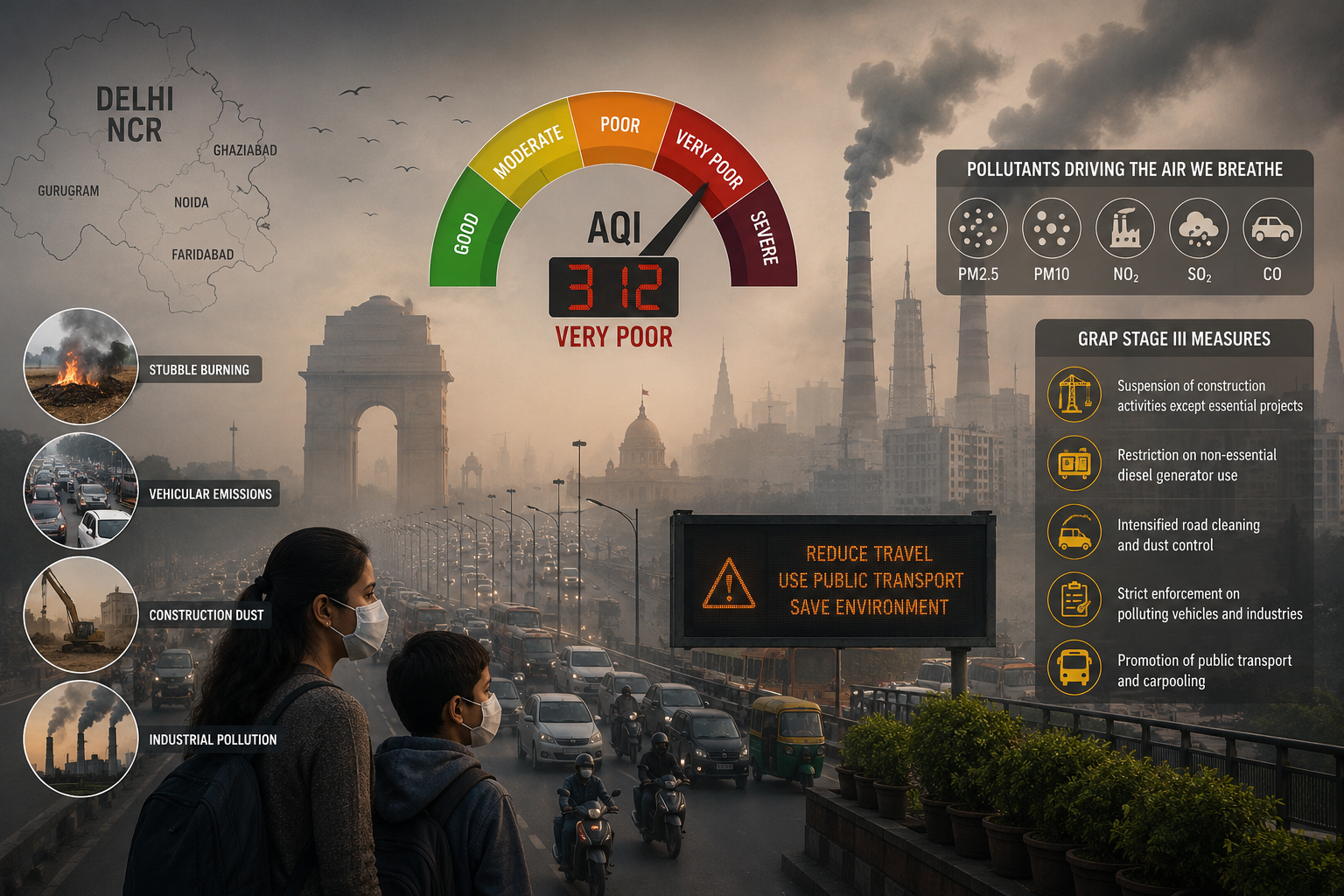
Delhi woke up to another hazy Tuesday. A day of stronger winds and light drizzle gave the capital a short break on Monday, but that relief is already fading, and the Graded Response Action Plan (GRAP) Stage III curbs that came into force on 6 November are still active across Delhi-NCR.
The Air Quality Early Warning System has forecast ‘very poor’ air for 17 November, with similar conditions likely over the next six days. For people in Delhi, Gurugram, Noida, Ghaziabad and Faridabad, that means the construction bans, vehicle limits and school changes will not be lifted this week.
This report covers the latest Delhi AQI readings, what GRAP Stage III actually restricts, why Delhi NCR pollution gets so severe every winter, and what residents can do while the air stays bad.
Delhi AQI Today: A Short Break That Did Not Last
As per the Commission for Air Quality Management (CAQM), Delhi’s citywide AQI stood at 288 at 1 am on 17 November. That falls in the ‘poor’ category. The number hides a lot, though. Around midnight, several monitoring stations were already showing ‘very poor’ readings, which tells you how uneven pollution is across the city.
The IITM dashboard, with readings taken at midnight, showed Sirifort at 393, Pusa at 381 and ITO at 374. Talkatora Garden recorded 363 and IIT Delhi 362. Chandni Chowk, Burari Crossing, North Campus and the Commonwealth Sports Complex also went above 300. PM2.5 was the dominant pollutant at most of these stations.
The picture changed by early morning in some pockets. ANI’s visuals from around 6 am showed Sarai Kale Khan at 259, which is ‘poor’, and the India Gate area at 198, which is ‘moderate’, as per CPCB data. So the same city, at nearly the same hour, was showing readings that ranged from moderate to very poor depending on where you stood.
Monday had looked better on paper. According to CPCB, Delhi’s 24-hour average AQI settled at 290 at 4 pm, down from 367 on Saturday. The improvement came from stronger winds and the influence of a western disturbance, which helped disperse pollutants. The India Meteorological Department (IMD) also recorded very light rain and drizzle at several places in the capital.
Experts had warned that this would not last. The IMD forecast for Tuesday points to mainly clear skies, with north-westerly winds shifting towards the north-east at speeds of up to 15 kmph. The ventilation index, which measures how well the atmosphere can disperse pollutants, is expected to fall compared with earlier readings. Weaker dispersion means whatever pollution has built up stays close to the ground.
How GRAP Stage III Came Into Force
This year’s winter pollution response has moved step by step. In the first week of November, air quality was in the ‘poor’ range with GRAP Stage I measures in place and the AQI hovering around 166 to 180 on some days. As the AQI entered the ‘very poor’ category, Delhi-NCR moved to Stage II.
On 6 November, CAQM invoked Stage III across the National Capital Region, a few days before Diwali. At that point, the AQI had touched 382, which is below the 401 mark that is generally linked to the ‘severe’ category. In other words, CAQM acted before the air formally crossed into severe territory, with the festival and a worsening trend in view.
Diwali did not help. IITM estimates showed that firecrackers contributed 71.1 per cent of Delhi’s PM2.5 during the early hours of 9 November, the morning after the festival. Smog covered landmarks across the capital that day, and by mid-November visuals from the city showed the air plunging into the ‘severe’ category again at one stage.
The Directorate of Education followed the Stage III order by asking Delhi schools to run classes up to Class 5 in hybrid mode from Saturday, 7 November. Parents can choose between online and physical attendance.
There is one more detail worth knowing. The revised GRAP schedule also carries vehicle-entry restrictions that apply from 1 November 2026 to 31 January 2027. These are meant to cut vehicular emissions across the whole winter season, not only on the worst days.
What Is Banned or Restricted Under GRAP Stage III
Stage III measures are added on top of everything already required under Stages I and II. Here is what applies across Delhi-NCR right now.
Construction and Demolition Restrictions
- A ban on non-essential construction and demolition work across the NCR, which covers earthwork, piling, trenching and open-air operations of ready-mix concrete (RMC) plants.
- Closure of stone crushers and suspension of mining activities.
Vehicle Restrictions
- BS-III petrol and BS-IV diesel four-wheelers face restrictions in Delhi and in the NCR districts of Gurugram, Faridabad, Ghaziabad, Gautam Buddha Nagar and Sonipat.
- Additional curbs apply to certain diesel goods vehicles. BS-IV and older medium goods vehicles registered in Delhi are restricted, and so are specified light commercial vehicles registered outside the capital.
- Entry of BS-IV diesel light commercial vehicles registered outside Delhi is barred, except those carrying essential commodities or providing essential services.
- Inter-state diesel buses that do not meet CNG, electric or BS-VI standards are not allowed to operate in Delhi.
School Rules
- Schools up to Class 5 run in hybrid mode, with an online option for students.
Advisories for the Public
- Residents are being asked to use public transport, avoid open burning of waste and biomass, and follow health advisories on limiting exposure to polluted air.
Some exemptions exist for emergency and essential services. If you run a business or drive a goods vehicle, the CAQM order and the notification from your state transport department are the documents to check, since the district-wise details differ.
GRAP Stages Explained: AQI Ranges and What Triggers Them
GRAP is a set of emergency measures that kick in as air quality worsens. It is applied in stages, and each stage adds to the one before it. The AQI ranges linked to the stages are as follows.
- Stage I (Poor): AQI 201 to 300
- Stage II (Very Poor): AQI 301 to 400
- Stage III (Severe): AQI 401 to 450
- Stage IV (Severe Plus): AQI above 450
Stage IV is the toughest. It involves measures such as halting truck traffic and banning construction of public infrastructure, along with wider emergency restrictions on traffic and industry.
The plan was first notified in 2017 and is now enforced by CAQM, the statutory body set up in 2021 to coordinate air quality management across Delhi and the neighbouring states. Its reach extends beyond the capital. That matters because a ban in Delhi alone would do very little if Gurugram, Noida or Ghaziabad kept running as usual.
A word of caution on how to read this. GRAP does not clean the air by itself. It tries to stop emissions from getting worse during the days when weather is working against the city. When winds pick up, the improvement comes mostly from the weather, as Monday showed.
Why Delhi-NCR Air Turns Toxic Every Winter
The same story repeats from late October. It comes down to geography, weather and emissions arriving together.
Delhi sits in a landlocked region with no sea breeze to flush out the air. As temperatures drop in winter, the air near the ground cools and a temperature inversion sets in. A layer of warmer air sits over it like a lid, and pollutants stay trapped below. Wind speeds fall, and the ventilation index drops with them.
On top of that, the sources of pollution do not take a break.
- Vehicles: The NCR has one of the largest vehicle populations in the country, and traffic emissions are constant through the year.
- Dust: Construction, road dust and demolition debris add coarse and fine particles. This is why construction bans sit at the centre of every GRAP stage.
- Industry and power: Industrial units and fuel burning in and around the region add to the load.
- Biomass burning: Open burning of garbage and crop residue in the neighbouring states contributes during the October and November window.
- Firecrackers: Diwali brings a sharp, short spike. This year’s IITM estimate of 71.1 per cent of PM2.5 in the early hours of 9 November shows how big that spike can get.
No single source explains the problem. The share of each changes from day to day with wind direction and speed, which is why researchers and officials often disagree on the exact breakdown on a given date.
Health Impact of Delhi Air Pollution: Who Is Most at Risk
PM2.5 refers to particles smaller than 2.5 microns, far thinner than a human hair. They travel deep into the lungs and can pass into the bloodstream. The World Health Organization’s 2021 guideline for PM2.5 is an annual average of 5 micrograms per cubic metre. India’s own national standard is 40 micrograms for the annual average and 60 for a 24-hour period. On a ‘very poor’ day in Delhi, readings sit well above both.
Short-term exposure can cause burning eyes, a scratchy throat, coughing and breathlessness. Long-term exposure is linked to chronic lung disease, heart problems and reduced lung development in children.
The groups that need to be most careful are:
- Children, especially younger ones
- Older adults
- People with asthma, COPD or heart conditions
- Pregnant women
- Outdoor workers, such as traffic personnel, delivery riders and construction labourers
The last group has the least choice. A person working at a signal or on a bike cannot stay indoors, and a construction ban also means lost daily wages for many workers. This is a part of the GRAP debate that rarely makes the headlines.
The hybrid-class order for primary students exists for this reason. Younger children breathe faster relative to their body size and spend more time outdoors, so they are exposed more.
What Residents Can Do While the Air Stays Bad
You cannot fix the city’s air on your own, but you can reduce how much of it you breathe in.
- Check the AQI before you plan the day. The CPCB’s official AQI data and the SAMEER app give station-wise numbers. City averages can mislead, as the readings above show.
- Use a proper mask. A well-fitted N95 or FFP2 mask works for outdoor trips. Cloth and surgical masks do very little against PM2.5.
- Move heavy exercise indoors on bad days. Running or cycling outdoors makes you inhale more polluted air. Early morning is often the worst time in winter, because the inversion is strongest then.
- Keep windows shut during peak hours. Air out the house when readings dip, usually in the afternoon.
- Use a HEPA purifier if you can, and keep it in the room where you spend most time. Check the filter on schedule.
- Take public transport or share rides. Fewer cars on the road helps during the weeks when every bit of emission counts.
- Do not burn waste or leaves. Open burning is banned, and the smoke adds directly to local pollution. Violations can be reported through the official complaint channels, including the Green Delhi app.
If you have a breathing condition, talk to your doctor about a plan for the high-pollution weeks. Do not wait for symptoms to get worse.
What to Watch Next for Delhi AQI and GRAP
Three things will decide how the coming week looks.
First, the weather. The forecast has ‘very poor’ air continuing for about six days. A fresh western disturbance or a spell of strong winds is the main thing that could change that. Without it, readings could drift higher.
Second, CAQM’s review. If the AQI climbs above 450, Stage IV measures could follow, which would mean tougher limits on truck traffic and public infrastructure work. If readings improve for a sustained period, the commission can ease the restrictions in steps.
Third, enforcement. Stage III only works if the bans are actually implemented on the ground, from construction sites to vehicle checks at district borders. Residents and civic groups will be watching how that goes.
The vehicle restrictions run until 31 January 2027, so the rules will stay in the background for the whole winter regardless of the daily AQI.
Frequently Asked Questions on Delhi-NCR Pollution and GRAP
What is GRAP in Delhi?
The Graded Response Action Plan is a set of emergency anti-pollution measures that apply in stages as Delhi-NCR’s air quality worsens. CAQM enforces it across the region.
When did GRAP Stage III come into force this year?
CAQM invoked Stage III across Delhi-NCR on 6 November 2026, ahead of Diwali, when the AQI had touched 382.
Is GRAP Stage III still in force?
Yes. As of 17 November 2026, the CAQM dashboard shows Stage III restrictions as active across the NCR.
What is the Delhi AQI forecast for this week?
The Air Quality Early Warning System expects ‘very poor’ air on 17 November, with similar conditions likely over the following six days.
Which vehicles are banned under GRAP Stage III?
BS-III petrol and BS-IV diesel four-wheelers face restrictions in Delhi and designated NCR districts. Certain older diesel goods vehicles and non-compliant inter-state diesel buses are also restricted.
Are schools closed in Delhi because of pollution?
Schools are not closed. Classes up to Class 5 run in hybrid mode, so students can attend physically or online.
What does PM2.5 mean?
PM2.5 is the term for fine particles smaller than 2.5 microns. They can enter the lungs and bloodstream, which makes them the most harmful pollutant in Delhi’s winter air.
Login to leave a comment.