


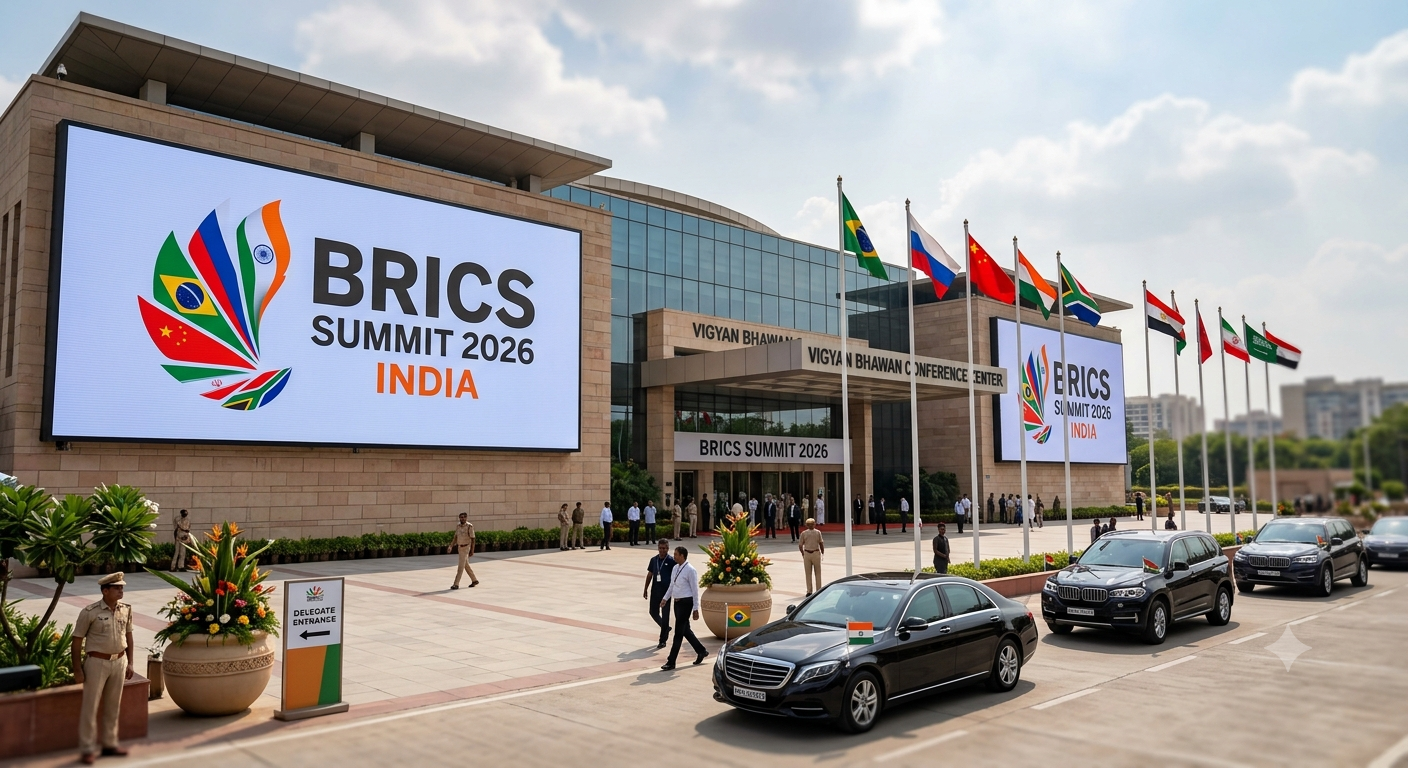
On September 12, 2026, at Bharat Mandapam in New Delhi, leaders of the BRICS bloc did something that looked genuinely uncertain just months earlier: they unanimously adopted a joint declaration. Prime Minister Narendra Modi announced the breakthrough to the room himself: “No member has raised any objections. The New Delhi Declaration 2026 has been adopted unanimously.” Given the group's composition — a bloc that includes Iran, Saudi Arabia, and the UAE alongside Russia, China, Brazil, India, and South Africa, all with differing and sometimes competing regional interests — that single sentence carried more weight than it might first appear.
This is the story of how that consensus came together, what's actually in the 140-point declaration, and why the 18th BRICS Summit matters well beyond the diplomatic photographs of world leaders shaking hands in New Delhi.
Setting the Scene: Why This Summit Was Different-
The 18th annual BRICS Summit ran over two days, bringing together eleven major emerging and developing economies under India's 2026 chairship — Brazil, China, Egypt, Ethiopia, Indonesia, India, Iran, Russia, Saudi Arabia, South Africa, and the UAE. India's theme for its chairship, "Building for Resilience, Innovation, Cooperation and Sustainability," set the tone for a summit that leaders framed less as a simple economic gathering and more as a platform for reshaping global governance itself.
The backdrop made this summit particularly tense. It arrived amid the US-Israel war on Iran, Russia's ongoing war in Ukraine, and broader global economic strain — all while the bloc itself had been showing signs of internal friction. A BRICS foreign ministers' meeting held in New Delhi back in May had ended without a joint statement at all, after consensus splintered over how to characterise the war in West Asia. Adding to the pressure, US President Donald Trump had previously threatened BRICS members with tariffs of up to 10 percent over what he called the bloc's "anti-American" policies.
The timing was also unusually pointed. The summit took place just before the second China-US summit of the year, with Chinese President Xi Jinping expected to meet Donald Trump for a state visit on September 24. Ian Lesser, a distinguished fellow at the German Marshall Fund of the United States, observed that against the backdrop of an increasingly fraught relationship with Europe and the US, the summit gave Russian President Vladimir Putin an opportunity to display his ties to leading countries of the Global South.
Who Showed Up-
Modi hosted a striking lineup in New Delhi: Russian President Vladimir Putin, Chinese President Xi Jinping, Iranian President Masoud Pezeshkian, Egyptian President Abdel Fattah el-Sisi, and counterparts from the bloc's other member states — more than a dozen world leaders in total. The Indian capital was visibly transformed for the occasion, decked out in BRICS-themed signage with illuminated buildings and roundabouts across the city.
High-profile visuals of Modi standing alongside Xi, Putin, and Pezeshkian dominated global media coverage. On the sidelines of the core meetings, leaders also toured the "India Innovates" exhibition at Bharat Mandapam, a showcase of the country's technology and innovation sector timed deliberately to coincide with the summit.
The Marathon Negotiation Behind the Declaration-
Getting to unanimous consensus wasn't smooth. Sherpas — the senior officials who negotiate summit outcomes on behalf of their leaders — held intensive discussions over several days, with negotiations reportedly continuing until the early hours of Saturday morning before agreement was finally reached, under India's mediation.
The single biggest sticking point was language describing the conflict in West Asia. Given that Iran, Saudi Arabia, and the UAE all sit within BRICS despite holding genuinely different positions and competing regional interests, finding wording everyone could accept required real diplomatic effort. Member states eventually agreed on language "deploring" all forms of "unprovoked aggression" — a formulation carefully calibrated to avoid singling out any one country by name while still registering collective concern.
That pattern — addressing serious global flashpoints without directly naming the parties involved — runs through much of the declaration. Ukraine, for instance, is notably absent by name entirely, despite the war's continued relevance to Russia's international standing.
Inside the New Delhi Declaration: The Major Themes-
The final document runs to roughly 140 paragraphs, and its scope reflects just how far BRICS's agenda has expanded from its original narrow economic focus.
- Global Governance and UN Reform — The declaration backs India and Brazil for expanded roles at the United Nations and pushes for IMF reform. Modi proposed BRICS members jointly formulate ten proposals for global governance reform, aiming toward a full BRICS Reform Roadmap. Collectively, BRICS members now account for roughly half the world's population, around 40 percent of global GDP, and about a quarter of global trade.
- Counter-Terrorism and the Pahalgam Attack — The declaration strongly condemned the April 22, 2025 terror attack in Jammu and Kashmir, which killed 26 people, calling for a zero-tolerance policy toward terrorism — language India has previously pushed for with mixed success.
- West Asia and Gaza — The bloc demanded an immediate Israeli ceasefire in Gaza, unimpeded humanitarian aid delivery, rejected forced relocation of Palestinian civilians, and endorsed full UN membership for Palestine alongside a two-state framework based on 1967 boundaries. It also expressed concern over Sudan, called for a Syrian-led political transition, and welcomed the Lebanon ceasefire.
- Trade, Tariffs, and De-Dollarisation — The bloc reaffirmed commitment to a WTO-centred trading system, opposing unilateral tariffs and non-compliant carbon border measures, while advancing local currency settlement and financial messaging interoperability as gradual steps away from dollar dependence.
- Artificial Intelligence — AI governance was formally folded into BRICS's core agenda alongside trade and finance, with commitments on cybersecurity and countering cross-border scam networks, plus a proposed Digital Public Infrastructure Repository.
- Energy, Climate, and Supply Chains — Energy security and supply chain resilience were framed as practical necessities, while climate language largely reaffirmed existing commitments.
The Diplomatic Stakes for India-
For India, successfully steering the bloc to unanimous consensus represents a genuine diplomatic achievement. At a previous summit hosted in Goa, India had pushed unsuccessfully to get the bloc to name specific terror organisations; it was only at a later summit hosted in China that Beijing agreed to name extremist outfits that had harmed Indian interests. This year, with India itself in the chair's seat, securing unanimous counter-terrorism language tied to Pahalgam represents a full-circle moment in that effort.
Hosting a successful summit — India's fourth time chairing BRICS, after 2012, 2016, and 2021 — reinforces its positioning as a bridge-builder for the Global South at a moment of rising protectionism and geopolitical fragmentation.
India's preparation stretched back months: the external affairs minister unveiled the chairship's logo and theme in January, and India hosted preparatory tracks including a BRICS Parliamentary Forum commitment and a BRICS RI International Conference to build consensus well before leaders arrived in New Delhi.
What Comes Next-
With India's chairship concluding, BRICS extended full support to China for the 2027 chairship and the 19th Summit. That handoff means initiatives launched in the New Delhi Declaration — AI governance, UN and IMF reform, the Reform Roadmap, and de-dollarisation work — now move forward under Chinese stewardship.
The real test ahead is implementation rather than language. Whether the Gaza ceasefire demands, counter-terrorism commitments, AI governance framework, and institutional reform push translate into concrete action will determine whether this summit is remembered as a turning point or simply a successful exercise in consensus-building under difficult circumstances.
The Expansion Story Behind BRICS's Growing Weight-
BRICS started as an informal grouping of four economies — Brazil, Russia, India, and China — with South Africa joining later. In 2023, the bloc extended invitations to Egypt, Ethiopia, Iran, Saudi Arabia, and the UAE. In 2025, ten additional Partner countries joined: Belarus, Bolivia, Cuba, Kazakhstan, Malaysia, Nigeria, Thailand, Uganda, Uzbekistan, and Vietnam.
That rapid expansion is precisely why reaching consensus has grown more difficult even as the bloc's collective weight has grown more impressive — an eleven-member core with ten partner countries spans Latin America, Africa, the Middle East, and Southeast Asia, each with distinct regional priorities. Viewed against that backdrop, this year's unanimous declaration looks like a genuine stress test the bloc's cohesion managed to pass.
The Bigger Picture-
What makes the 18th BRICS Summit worth paying attention to isn't just its content, but its context. A bloc containing members with genuinely opposed regional interests — Iran and Saudi Arabia, for instance — managed to produce a unanimous 140-point statement addressing some of the most contentious issues in global politics today, from Gaza to AI governance to UN reform.
Whether BRICS ultimately succeeds in translating this consensus into lasting influence over global governance remains an open question. But in a year marked by wars in multiple regions, rising tariff threats, and growing scepticism toward existing international institutions, eleven nations representing roughly half the world's population managed to agree on a shared statement of priorities — and in the current geopolitical climate, that alone counts as a notable outcome.
Quick Summary Table: New Delhi Declaration at a Glance-
| Theme | Key Position |
| UN & Global Governance | Backs India & Brazil for expanded UN roles; 10-point Reform Roadmap proposed |
| Counter-Terrorism | Condemns Pahalgam attack; zero-tolerance policy on terrorism |
| West Asia / Gaza | Demands ceasefire, humanitarian aid, two-state solution |
| Trade & Finance | Opposes unilateral tariffs; advances local currency settlement |
| AI & Technology | AI governance formalised as a core pillar alongside trade & finance |
| Next Chairship | China to host the 19th BRICS Summit in 2027 |
For a bloc this diverse, unanimous consensus is the headline — what happens with implementation over the next year is the story worth following next.
Login to leave a comment.