

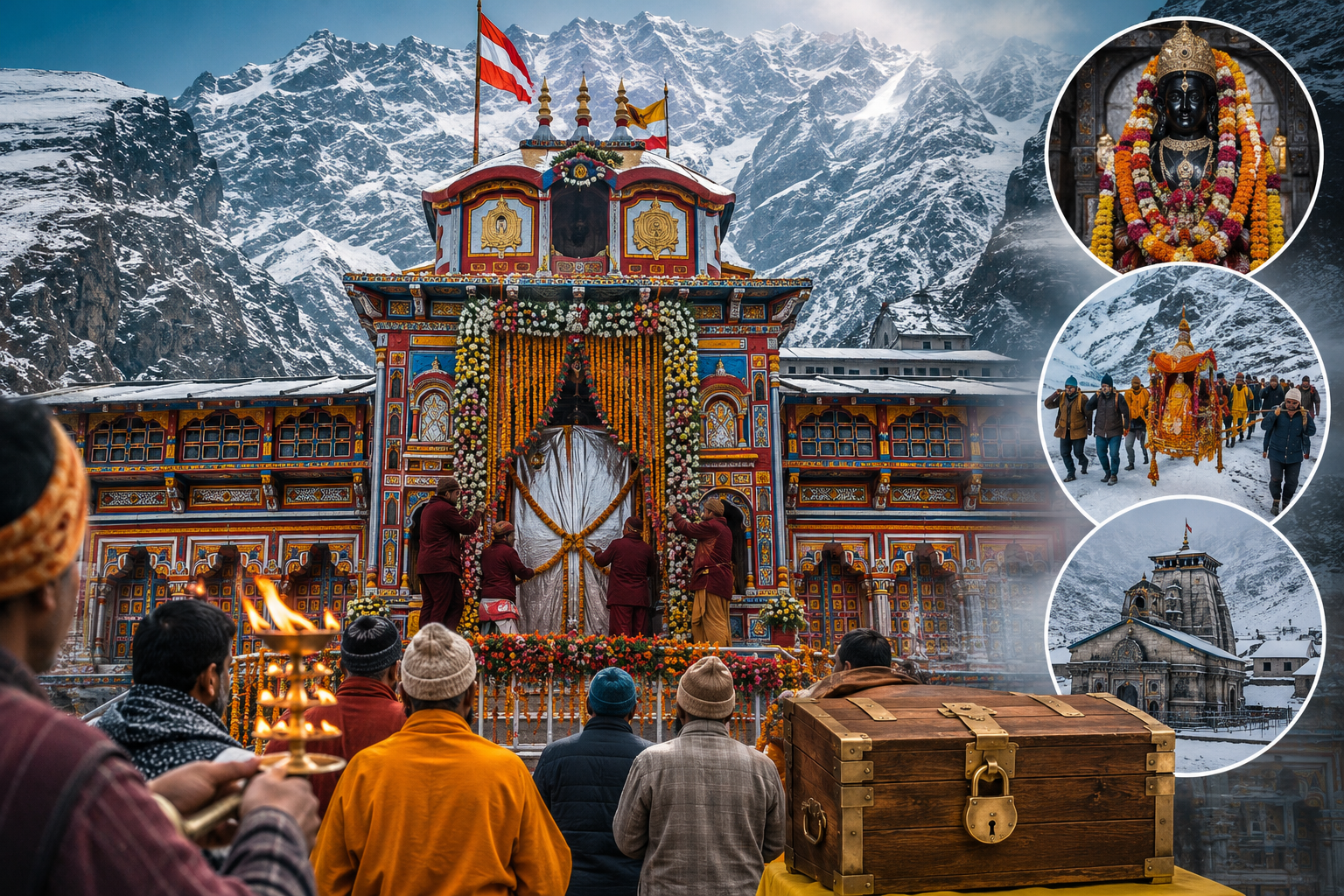
The doors of Badrinath Dham closed for the winter on the night of Monday, 16 November 2026. The kapat band ceremony took place at 9:37 pm, and with it the Char Dham Yatra for this year came to its formal end.
Thousands of devotees were at the temple in Chamoli district for the final rituals. The shrine was decorated with flowers, an Army band played, and chants of “Jai Badri Vishal” filled the premises through the day. For the next six months, the Himalayan temple will stay shut, and worship of Lord Badrinath moves down the mountain.
This report covers the closing time and rituals, the five-day Panch Puja schedule, what happens to the deities after the doors shut, the pilgrim numbers for 2026, and where devotees can offer prayers through the winter.
Badrinath Dham Closing 2026: Date, Time and Announcement
The closing date was not a surprise. By tradition, the date for the Badrinath kapat band is announced on Vijayadashami. This year, that announcement came on 20 October, when the Rawal, the chief priest of the temple, and the Dharmadhikari fixed the time. They did so in the presence of priests and traditional rights-holders, after a special offering to Lord Badri Vishal and calculations based on the Hindu almanac.
The auspicious moment they settled on was 9:37 pm on 16 November, in Karka lagna. The temple opened for the season on 23 April 2026, so the doors stayed open for a little under seven months.
A few online guides had listed other dates earlier in the year, such as 6 November or 13 November. Those were guesses based on past years. The official date, as announced on Vijayadashami and followed on the ground, is 16 November.
The Final Day at Badrinath: What Happened
Worship and rituals were under way from the morning of 16 November. Devotees gathered to watch the last ceremonies of the season, and the line at the sanctum stayed long right up to the evening.
The key moment came shortly before the doors closed. Goddess Lakshmi was brought into the sanctum of Lord Badrinath. The idols of Uddhav and Kuber were brought outside. After Lakshmi was placed inside, Lord Badrinath was covered with a ghrit kambal, a blanket soaked in ghee. An akhand jyoti, a lamp meant to burn continuously, was lit inside. Then the main gates were shut at the appointed hour.
Uttarakhand Chief Minister Pushkar Singh Dhami marked the moment on social media. He wrote that the portals of Shri Badrinath Dham had been closed for the winter season with full traditional rites, and that the Char Dham Yatra for 2026 had officially concluded.
Panch Puja: The Five-Day Ritual Before the Kapat Band
The closing is not a one-day event. Badrinath follows five days of rituals known as Panch Puja, which started on 12 November. Each day closes a part of the temple complex or completes a particular observance.
- 12 November: The Panch Puja began. The temple of Lord Ganesha within the complex was closed.
- 13 November: The Adi Kedareshwar Temple and the Adi Shankaracharya Temple were closed.
- 14 November: Observances linked to Khadga Pustak were held, and the Vedic recitations concluded.
- 15 November: Special offerings were made to Goddess Lakshmi, followed by the invitation for her to enter the main shrine.
- 16 November: Lakshmi was placed in the sanctum, Uddhav and Kuber were brought out, and the doors closed for the season.
The order matters to the priests. Each step prepares the temple to be left in the care of the goddess and the sacred lamp for the winter months.
Why the Rawal Dresses as a Woman: The Lakshmi Ritual
One of the best-known traditions at the closing is the part played by the Rawal. Before the doors shut, the chief priest dresses as a woman to carry the idol of Goddess Lakshmi into the sanctum.
The reason comes from local belief. Uddhav, the close companion of Lord Krishna, is regarded as older than Krishna. That makes him the elder brother-in-law of Goddess Lakshmi. In keeping with the custom that a daughter-in-law does not appear before her elder brother-in-law, Lakshmi is brought into the sanctum only after Uddhav has left it.
The Rawal then takes the role of a sakhi, a female companion, and carries the idol inside. Devotees also link the practice to the belief that the goddess should not be touched by an unrelated man. The ritual is centuries old, and it is still carried out each year with the same seriousness.
After the Closing: Where the Deities Go for Winter
The movement does not stop when the doors close. On Tuesday, 17 November, the idols of Uddhav and Kuber, along with the sacred seat of Adi Guru Shankaracharya, leave Badrinath for their winter destinations in Pandukeshwar and Joshimath.
This shift is the reason winter worship does not stop altogether. For the next six months, devotees can offer prayers at two places.
- Yogadhyan Badri Temple, Pandukeshwar
- Narsingh Temple, Joshimath
According to a belief mentioned in coverage of the closing, Lord Vishnu rests during the winter months. The region around Badrinath becomes difficult to reach once snow sets in, so the main deity’s worship moves to a warmer place at lower height. When the snow clears in spring, the deity returns, and the gates are opened for devotees.
Other Dhams Have Already Closed: The 2026 Closing Timeline
Badrinath is the last of the four Uttarakhand dhams to shut, which is why its closure marks the end of the whole yatra. The other shrines closed over the previous week.
- Gangotri: closed on 10 November.
- Kedarnath and Yamunotri: closed on 11 November.
- Madhyamaheshwar: the second of the Panch Kedars, closed at 8 am on 16 November, the same day as Badrinath.
- Badrinath: closed at 9:37 pm on 16 November.
Kedarnath’s doors shut at 8:30 am on 11 November, with the Army band playing and a large crowd present for a last glimpse of Lord Shiva. According to Badarinath-Kedarnath Temple Committee (BKTC) President Hemant Dwivedi, more than 19.20 lakh devotees visited Kedarnath this season.
With Yamunotri closed, regular pilgrimage to that shrine ended, and the goddess is worshipped through the winter at Kharsali village. Gangotri’s winter worship is held at Mukhba. Kedarnath’s winter seat is the Omkareshwar Temple in Ukhimath.
Madhyamaheshwar’s Doli Begins a Four-Day Journey
The Madhyamaheshwar closure also set a procession in motion. After the gates closed in Rudraprayag district, the chal vigraha utsav doli, the ceremonial palanquin carrying the movable idol, left for the deity’s winter seat at Omkareshwar Temple in Ukhimath.
The journey takes four days, with overnight halts in villages on the way.
- 16 November: Gaundar village, first night halt.
- 17 November: Rakeshwari Temple in Ransi.
- 18 November: Giriya village.
- 19 November: Arrival at Omkareshwar Temple in Ukhimath, with traditional welcome ceremonies and special prayers.
Winter worship of Lord Madhyamaheshwar begins at Ukhimath once the doli arrives. During the season, reaching Madhyamaheshwar means a demanding trek through the mountains, so the shift to Ukhimath makes the deity reachable for far more people.
Char Dham Yatra 2026: Pilgrim Numbers
The closing also brought the season’s figures. Chief Minister Dhami said that more than 65 lakh pilgrims, from across India and abroad, visited the four sacred shrines during the 2026 Char Dham Yatra. He added that more than 23 lakh pilgrims came to Badrinath Dham alone, which he called a new milestone.
Some context helps here. These are numbers given by the state government, and they count visits to the shrines during the season. They are a useful measure of how large the yatra has grown, but they are not an independent count. If you are writing about crowd management, road safety or the local economy, it is worth checking with the district administration for a breakdown.
Still, the scale is clear. Badrinath’s share of 23 lakh, against 19.20 lakh at Kedarnath, shows how heavy the load is on a small town at around 3,100 metres above sea level, in a season of roughly seven months.
About Badrinath Dham
Badrinath is dedicated to Lord Vishnu, who is worshipped here as Badrinath or Badri Vishal. The temple stands in the town of Badrinath in Chamoli district of Uttarakhand and is one of the four Char Dham shrines in the state. It is also counted among the 108 Divya Desams, the sacred sites of Vishnu.
The temple’s season is short and fixed by weather. It opens after Akshaya Tritiya, usually in late April or May, and shuts in November. Heavy snowfall makes the area inaccessible in winter. This year, snowfall had already covered the peaks around the temple in late October as temperatures dropped.
What Visitors and Devotees Should Know Now
If you planned to visit Badrinath and missed the season, you still have options. Here is what is practical.
- Do not travel to Badrinath for darshan. The temple is closed until spring, and winter conditions can make the route unsafe.
- Plan a visit to Joshimath or Pandukeshwar instead. Winter worship happens at the Narsingh Temple in Joshimath and the Yogadhyan Badri Temple in Pandukeshwar.
- Check road and weather updates before you start. Mountain roads in Chamoli can see snow, landslides and closures. Local administration and traffic advisories are the best source.
- Carry warm clothing. Even the lower winter seats are cold in the mornings and evenings.
- Verify the reopening date in spring. Pilgrimage dates are fixed on traditional occasions, and online guides often print guesses. Wait for the official announcement.
When Will Badrinath Reopen?
The exact reopening date for 2027 has not been announced. By tradition, the opening date is decided in a ceremony at the Raj Darbar in Narendra Nagar, the palace of the former Tehri Garhwal rulers, on Basant Panchami. This year, the temple opened on 23 April, at 6:15 am, following Akshaya Tritiya. Expect a similar window in spring 2027, but treat any date you see before the official announcement as tentative.
Frequently Asked Questions on Badrinath Dham Closing 2026
When did Badrinath Dham close in 2026?
Badrinath Dham closed for winter at 9:37 pm on Monday, 16 November 2026.
Who decided the Badrinath closing date?
The Rawal and the Dharmadhikari fixed the date and time on Vijayadashami, 20 October, after a special offering to Lord Badri Vishal and almanac calculations.
What is Panch Puja at Badrinath?
Panch Puja is the five-day set of closing rituals. In 2026, it ran from 12 November to 16 November.
Why does the Rawal dress as a woman before the doors close?
As per local belief, Goddess Lakshmi is brought into the sanctum only after her elder brother-in-law Uddhav has left. The Rawal takes the role of a female companion to carry her idol inside.
Where is Lord Badrinath worshipped in winter?
At the Yogadhyan Badri Temple in Pandukeshwar and the Narsingh Temple in Joshimath.
How many pilgrims visited Badrinath in 2026?
According to Chief Minister Pushkar Singh Dhami, more than 23 lakh pilgrims visited Badrinath Dham, out of over 65 lakh across all four Char Dham shrines.
When did Kedarnath close in 2026?
Kedarnath closed on 11 November 2026 at 8:30 am.
Login to leave a comment.