


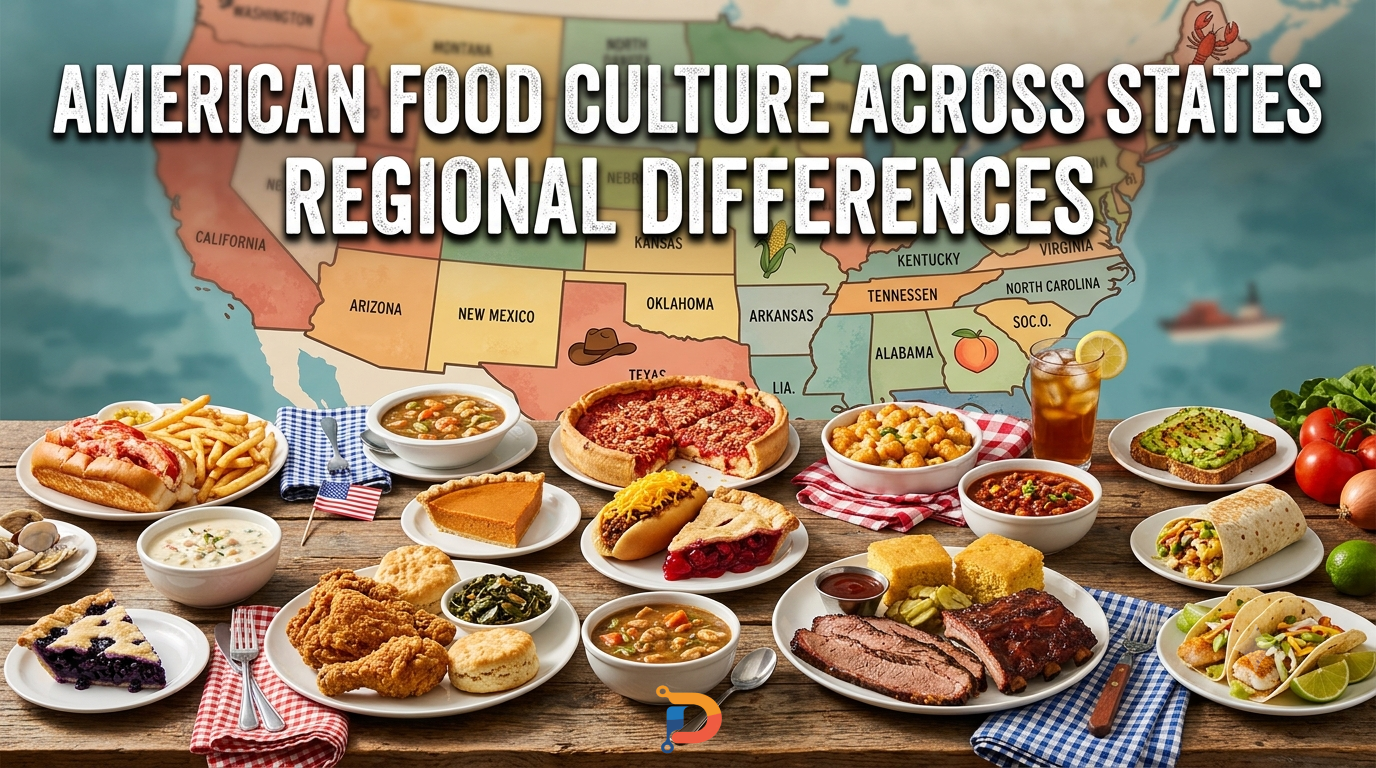
Ask someone what "American food" means, and you'll likely get a short list: burgers, fries, maybe apple pie. That answer isn't wrong, exactly — it's just incomplete in almost the same way that calling India's food scene "curry" would be. The United States is a country built from waves of migration, regional agriculture, and centuries of local adaptation, and its food culture reflects every bit of that complexity. Drive across state lines and you'll find barbecue traditions that consider each other rivals, seafood cultures shaped entirely by coastline, and dishes that exist almost nowhere outside a fifty-mile radius. This is a tour through that regional patchwork — the real, fractured, deeply local food culture that exists underneath the single word "American."
Why American Food Culture Isn't One Thing-
The United States spans a continent, and its food history is really several histories layered on top of each other: Indigenous agricultural traditions that predate European arrival, the foodways brought by English, German, Scandinavian, and other European settlers, the profound and often painful influence of enslaved West African communities on Southern cuisine, waves of immigration from Italy, China, Mexico, and beyond, and more recent culinary innovation shaped by immigration from every corner of the globe.
Add to that an enormous range of climate and geography — coastal seafood access, Midwestern grain belts, Southern humidity suited to slow-cooking, Southwestern desert agriculture — and you get a country where food culture was never going to be uniform. What holds it together isn't a shared cuisine so much as a shared history of adaptation, immigration, and regional pride.
The Northeast: Seafood, Delis, and Old-World Roots-
The Northeastern United States carries some of the country's oldest food traditions, shaped heavily by coastal access and waves of European immigration.
- New England Clam Chowder — A creamy, potato-based soup built around clams, deeply tied to the region's fishing industry. Boston and coastal Massachusetts consider their version the definitive one, often served in a bread bowl at seaside restaurants.
- Maine Lobster Rolls — Cold lobster meat tossed lightly in mayonnaise and served in a griddled, split-top bun. Maine's cold Atlantic waters produce much of the country's lobster supply, and the roll has become the state's signature food export.
- New York City Delis and Bagels — Shaped heavily by Jewish immigration in the late 19th and early 20th centuries, New York's bagel-and-lox culture and pastrami-piled deli sandwiches remain distinct enough that New Yorkers insist the city's water is what makes its bagels impossible to replicate elsewhere.
- Philadelphia Cheesesteaks — Thinly sliced steak grilled with onions and melted cheese, served on a long roll. The rivalry between Philadelphia's Pat's King of Steaks and Geno's Steaks, sitting across the street from each other, has become a local institution in itself.
The South: Barbecue Wars and Soul Food Roots-
No American region argues about food more passionately — or more locally — than the South, where barbecue style can change dramatically within the same state.
- Texas Barbecue — Centered on beef, particularly brisket, slow-smoked over post oak wood and often served with minimal sauce, letting the meat and smoke speak for themselves. Central Texas towns like Lockhart are considered pilgrimage sites for brisket devotees.
- Memphis and Carolina Barbecue — Memphis leans toward pork ribs, dry-rubbed or wet with a tomato-based sauce, while the Carolinas split further into their own factions — eastern North Carolina favoring a vinegar-based whole-hog style, while South Carolina is known for a distinctive mustard-based sauce found almost nowhere else in the country.
- Soul Food — Rooted in the culinary traditions of enslaved West African communities and shaped further during the Great Migration, soul food includes dishes like fried chicken, collard greens, black-eyed peas, and cornbread, carrying deep cultural and historical significance well beyond their ingredients.
- Louisiana's Creole and Cajun Cuisine — Two related but distinct traditions: Creole cuisine, associated with New Orleans' urban, French-Spanish-African-Caribbean blend (gumbo, jambalaya), and Cajun cuisine, tied to rural Acadian communities and typically spicier, heartier fare built around a dark roux.
The Midwest: Comfort Food and Immigrant Heritage-
Shaped by German, Scandinavian, and Eastern European immigration alongside the region's role as America's agricultural heartland, Midwestern food culture leans heavily toward hearty, unfussy comfort food.
- Chicago Deep Dish Pizza — A thick, pie-like pizza with a buttery crust, layered with cheese beneath rather than on top of a chunky tomato sauce. Chicago also claims the Chicago-style hot dog, famously never topped with ketchup by local tradition.
- Wisconsin Cheese Culture — Wisconsin's dairy industry, heavily shaped by German and Scandinavian settlers, has made the state synonymous with cheese production, cheese curds, and the affectionate self-identification of residents as "cheeseheads."
- Minnesota's Scandinavian Influence — Dishes like lutefisk and various hotdish casseroles trace directly back to Norwegian and Swedish immigrant communities, particularly around church potlucks and community gatherings.
- St. Louis-Style Toasted Ravioli and Gooey Butter Cake — Regional specialties found almost exclusively within the St. Louis metro area, illustrating how hyper-local some Midwestern food traditions remain even today.
The Southwest: Indigenous and Mexican Culinary Fusion-
The Southwest's food culture draws directly from Indigenous agricultural traditions and centuries of Mexican culinary influence, producing flavors distinct from Mexican food found elsewhere in the country.
- New Mexican Chile Culture — New Mexico's Hatch Valley green chiles are treated with the kind of regional pride usually reserved for wine appellations, showing up in everything from breakfast burritos to the state's official question, "red or green?"
- Tex-Mex — A distinct Texan fusion of Mexican and American culinary traditions, featuring dishes like the beef-and-cheese-heavy nachos, fajitas, and chili con carne, which developed independently from cuisine found in Mexico itself.
- Arizona's Sonoran Hot Dog — A bacon-wrapped hot dog piled with pinto beans, onions, tomatoes, and condiments, reflecting the strong Sonoran Mexican influence in Tucson and southern Arizona.
- Navajo Fry Bread — A dish with a complicated history, born out of government-forced relocation and food scarcity for Indigenous communities in the 1860s, now reclaimed and celebrated across Southwestern Indigenous communities as both comfort food and a symbol of resilience.
The West Coast: Farm-to-Table and Global Fusion-
California's Mediterranean-like climate and agricultural abundance, combined with waves of Asian and Latin American immigration, have made the West Coast a hub for both farm-driven cuisine and cross-cultural fusion.
- California Cuisine — Pioneered in the 1970s by chefs emphasizing fresh, local, seasonal ingredients, this farm-to-table philosophy has since spread nationally but remains most closely associated with Northern California's produce-rich Bay Area.
- San Francisco's Mission-Style Burrito — A large, foil-wrapped burrito packed with rice, beans, meat, and often sour cream, developed within the city's Mission District and now a template replicated (and argued over) nationwide.
- Los Angeles' Korean-Mexican Fusion — The Kogi Korean BBQ food truck, launched in Los Angeles, is widely credited with pioneering the modern American food truck movement and popularizing Korean-Mexican fusion dishes like the Korean short rib taco.
- Pacific Northwest Seafood — Seattle and Portland's proximity to cold Pacific waters has built a food culture centered on salmon, Dungeness crab, and oysters, alongside a strong coffee culture that gave rise to the modern American espresso boom.
Hawaii and Alaska: Food Cultures Shaped by Isolation-
The two states physically separated from the mainland have developed food cultures shaped as much by geographic isolation as by their unique populations.
- Hawaiian Plate Lunch — A combination of rice, macaroni salad, and a protein like kalua pork or teriyaki chicken, reflecting the state's plantation-era mix of Native Hawaiian, Japanese, Filipino, Portuguese, and Chinese labor communities.
- Poke — Originally a simple Native Hawaiian dish of cubed raw fish, seasoned and served over rice, poke has since become a global trend, though Hawaii's original, simpler preparations remain distinct from the elaborately topped versions found on the mainland.
- Alaskan Seafood and Subsistence Traditions — Salmon, halibut, and king crab dominate Alaskan food culture, alongside subsistence hunting and fishing traditions maintained by many of the state's Indigenous communities, shaped by the practical realities of a remote, resource-rich, but logistically isolated state.
The Mid-Atlantic: Crab Culture and Diner Traditions-
- Maryland Blue Crab — Steamed with Old Bay seasoning and served on newspaper-covered tables, Maryland's blue crab tradition around the Chesapeake Bay is treated as a near-sacred summer ritual.
- New Jersey Diner Culture — New Jersey has one of the highest concentrations of diners in the country, serving as informal community hubs offering everything from breakfast to late-night meals around the clock.
- Pittsburgh's Primanti Bros Sandwiches — A sandwich piled with meat, coleslaw, and french fries stacked directly inside the bread, a distinctly Pittsburgh invention rarely replicated with the same combination elsewhere.
Regional Dessert Traditions-
Beyond savory dishes, America's regional identity shows up just as clearly in dessert traditions, many tied to specific crops or immigrant communities.
- Key Lime Pie, Florida — Made with the small, tart Key limes grown in the Florida Keys, this pie is considered so regionally specific that the state has floated legislation over the years to protect its "authentic" naming.
- Boston Cream Pie, Massachusetts — Despite the name, actually a cake — layered sponge filled with custard and topped with chocolate glaze, invented at a Boston hotel in the 1850s and now the official state dessert.
- Pecan Pie, the South — Tied to the pecan trees native to the southern United States, this pie became a Southern staple particularly around the holidays, with Texas and Georgia both claiming particularly strong pecan-growing traditions.
- Kringle, Wisconsin — A layered, flaky pastry brought by Danish immigrants to Racine, Wisconsin, which has since been officially designated the state's pastry.
What People Drink Says as Much as What They Eat-
Regional identity extends well past the plate. Beverage culture across the United States follows the same pattern of local pride and geographic influence.
- Sweet Tea, the South — So central to Southern identity that some restaurants in the region serve it as a default rather than an option, and asking for unsweetened tea can occasionally draw a surprised look from servers in smaller towns.
- Craft Beer, the Pacific Northwest and Colorado — Oregon and Colorado in particular have built strong craft brewing identities, driven by hop-growing regions in the Pacific Northwest and a broader outdoor, brewery-taproom culture in Colorado's mountain towns.
- Bourbon, Kentucky — By federal designation, bourbon must be made in the United States, but Kentucky's limestone-filtered water and long tradition of distilling have made it synonymous with the spirit, complete with an official Bourbon Trail for visitors.
- Coffee Culture, the Pacific Northwest — Seattle's coffeehouse culture, which gave rise to major national chains, remains distinct in its emphasis on independent roasters and espresso quality, something locals often contrast with the more standardized coffee culture found elsewhere in the country.
Fast Food's Surprisingly Regional Origins-
Even the fast food chains that feel thoroughly national today often started as intensely regional operations, and many retain specific menu items or preparation styles tied to their home states.
- In-N-Out Burger, California — Remains deliberately limited to a handful of western states, and its "animal style" secret menu terminology has become a badge of West Coast food culture recognized well beyond the region itself.
- Whataburger, Texas — Functions almost as a piece of Texan identity as much as a burger chain, with a devoted following that treats its orange-and-white color scheme as a symbol of home for Texans living elsewhere.
- Waffle House, the South — So embedded in Southern culture that FEMA has informally used whether a local Waffle House stays open during a storm as an unofficial gauge of disaster severity, a phenomenon now commonly called the "Waffle House Index."
- Culver's, Wisconsin — Known for its butter burgers and frozen custard, reflecting Wisconsin's dairy-heavy food identity even within a fast food format.
State Fairs: Regional Food Culture on Full Display-
If there's one event that puts regional food identity on the clearest possible display, it's the American state fair — an annual tradition in nearly every state that mixes agriculture, competition, and often extreme culinary creativity.
The Iowa State Fair and Minnesota State Fair, both rooted in the country's agricultural heartland, are particularly known for pushing deep-frying to its creative limits, with vendors competing each year to introduce increasingly unusual deep-fried foods, from candy bars to entire meals on a stick. The Texas State Fair is famous for similarly inventive fried creations alongside its massive corny dog culture, while fairs in dairy-heavy states like Wisconsin lean more heavily into cheese-based novelties. Attending a state fair, more than almost any restaurant, tends to reveal what a region's food culture values — abundance, inventiveness, and a good deal of showmanship.
Why These Differences Persist in an Era of Chain Restaurants-
It would be reasonable to assume that national fast food and grocery chains have flattened regional food culture over the past several decades. In some ways, they have. But regional identity in food has proven remarkably resilient, for a few specific reasons.
Local pride is tied to identity, not convenience. Arguing about the "correct" way to make barbecue, chili, or a hot dog isn't really about the food itself — it's a way communities express identity and distinguish themselves from neighboring regions.
Ingredients still depend on geography. Fresh Gulf shrimp, Chesapeake blue crab, and Pacific Northwest salmon are genuinely easier to source, fresher, and more central to daily life in their home regions than anywhere else, which naturally anchors certain dishes to certain places.
Immigration keeps refreshing regional cuisine. Rather than diluting local food culture, new immigrant communities have historically added new layers to it — Vietnamese food in Houston, Ethiopian food in Washington D.C., Somali food in Minneapolis — creating new regional specialties rather than replacing old ones.
Food media has, if anything, deepened regional rivalries. The rise of food television and online content has given local specialties like Nashville hot chicken or Detroit-style pizza national visibility, often intensifying rather than softening the sense that these dishes belong to a specific place.
Thanksgiving: One Holiday, Many Regional Menus-
Thanksgiving is often presented as America's one truly unified food holiday, but even here, regional variation runs deep beneath the shared turkey-and-stuffing framework.
- Stuffing vs. Dressing — The Northeast and Midwest generally favor bread-based stuffing cooked inside the turkey, while much of the South prefers cornbread dressing baked separately in a pan, a distinction Southern cooks tend to defend firmly.
- Sweet Potato Casserole, the South — Topped with marshmallows or a pecan streusel, this dish is a Southern Thanksgiving staple that remains far less common on tables in other parts of the country.
- Green Bean Casserole, the Midwest — Built around canned cream of mushroom soup and fried onions, this dish originated at Campbell's headquarters but became most deeply embedded in Midwestern holiday tradition.
- Portuguese and Hawaiian Additions — In Hawaii, Thanksgiving tables often include dishes like Portuguese sausage or mac salad alongside turkey, reflecting the state's plantation-era immigrant heritage even within an otherwise mainland-derived holiday.
A Traveler's Approach to Eating Across America-
For a visitor trying to actually understand this patchwork rather than just sample a "greatest hits" list, a few principles help:
- Ask locals to argue, not just recommend. Regional food debates — Texas versus Carolina barbecue, thin versus deep dish pizza — often reveal more about a place's identity than a straightforward restaurant recommendation would.
- Eat where the dish actually originated, not just where it's popular. A Philly cheesesteak from a Philadelphia corner shop and a Maine lobster roll from a coastal shack carry a context that a chain restaurant version elsewhere simply can't replicate.
- Look past the state's most famous city. Texas barbecue outside major cities, in small towns like Lockhart, is often considered more authentic than versions found in Austin or Dallas.
- Pay attention to what pairs with the food. Sweet tea in the South, drip coffee culture in the Pacific Northwest, and craft beer traditions in states like Colorado and Oregon are as much a part of regional food identity as the dishes themselves.
Regional Slang and Naming Battles-
Regional food identity even extends to what people call the same basic items, and these naming differences are argued about with surprising intensity.
- Soda, Pop, or Coke — The Northeast and West Coast generally say "soda," the Midwest and parts of the Northwest say "pop," and much of the South uses "coke" as a generic term for any carbonated soft drink, regardless of brand.
- Sub, Hoagie, or Grinder — A long sandwich on a roll goes by different names depending on the region: "sub" is common nationally, but Philadelphia insists on "hoagie," while parts of New England favor "grinder."
- Crawfish or Crawdad — Louisiana's Cajun communities almost universally say "crawfish," tied closely to the state's boil culture, while some inland and Southern communities use "crawdad" for the same freshwater crustacean.
These naming quirks might seem trivial, but they function as quick identity markers — a single word choice can reveal roughly where in the country someone grew up.
Quick Summary Table: American Food Culture by Region-
| Region | Signature Foods |
| Northeast | Clam chowder, Maine lobster rolls, NYC bagels & deli, Philly cheesesteak |
| South | Texas & Carolina barbecue, soul food, Creole & Cajun cuisine |
| Midwest | Chicago deep dish, Wisconsin cheese, Scandinavian hotdish, St. Louis specialties |
| Southwest | New Mexican chile, Tex-Mex, Sonoran hot dog, Navajo fry bread |
| West Coast | California cuisine, Mission burrito, Korean-Mexican fusion, PNW seafood |
| Hawaii & Alaska | Plate lunch, poke, Alaskan salmon & subsistence traditions |
| Mid-Atlantic | Maryland blue crab, NJ diners, Pittsburgh Primanti sandwiches |
Pick one region per trip rather than trying to sample all of them at once — regional American food rewards depth in one place far more than a rushed cross-country tasting tour.
Login to leave a comment.