


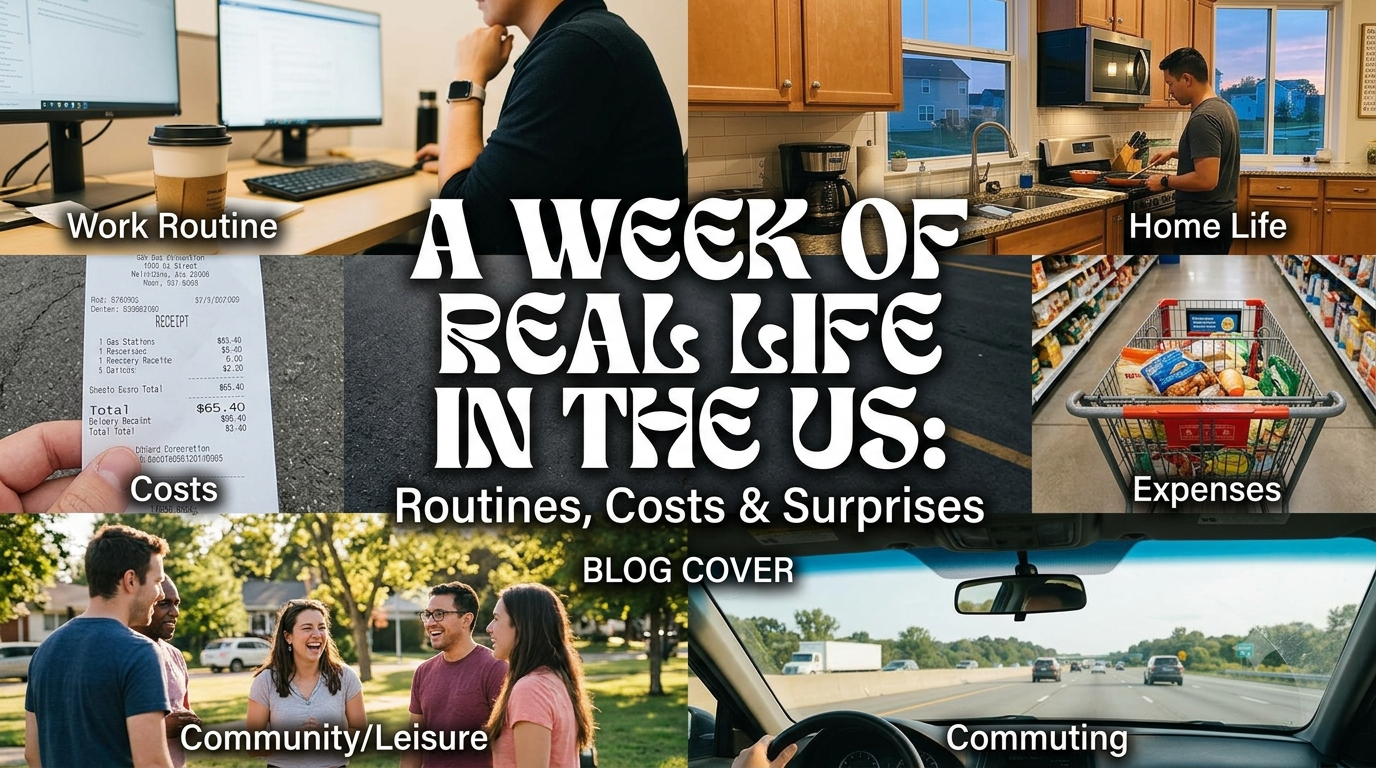
Most people picture the US through movies: yellow taxis, big diners, wide highways, a red cup in every hand. Then they land, and the first week feels nothing like the screen version. The trip from the airport is longer than expected, the price on the shelf is not the price at the till, and nobody tells you that walking to the shop is sometimes not an option at all. This post walks through one ordinary week, Monday to Sunday, the way a regular person living in a mid-sized American city might experience it. It covers routines, what things cost, and the small surprises that catch visitors and new arrivals off guard.
First, a Quick Note on "Typical"
There is no single American week. Someone in Manhattan who never owns a car has a different life from someone in suburban Texas who drives forty minutes to work. Rent, taxes, food prices and even the weather change enormously from state to state. The week below is built around a middle-of-the-road situation: a working adult in a mid-sized city, renting an apartment, owning or leasing a car, and living on a decent but not extravagant income. Every dollar figure here is a rough range, and you should treat it as a starting point rather than a quote.
If you are planning a trip or a move, the useful part is not the exact number. It is the pattern of where money goes and where time goes.
Monday: The Car Decides Everything
The week usually starts early. Many offices begin at eight or nine, and school buses run before that, so the first hour of the day is often a rush of packed lunches, coffee and traffic.
The biggest thing to understand about Monday mornings is that in most of the country, life is built around the car. Outside a handful of cities such as New York, Boston, Chicago, San Francisco and Washington D.C., public transport is limited. Buses may come every 30 to 60 minutes, and some neighborhoods have no sidewalks at all. A grocery store that looks close on the map can be a fifteen-minute drive because the road is a highway with no safe way to cross it.
That has a real cost. Owning a car means paying for the vehicle or the monthly loan, insurance, fuel, registration and maintenance. A car payment of $350 to $600 a month is common, and insurance alone can run from $100 to over $250 a month depending on the state, the driver's age and record. Petrol, which Americans call gas, is sold by the gallon (about 3.8 liters) and has generally sat somewhere between $3 and $5 a gallon depending on the year and the state. California is usually the priciest, while parts of the South and Midwest are cheaper.
A few small things from a Monday drive that surprise newcomers:
- You pump your own gas in nearly every state. New Jersey and Oregon have historically had attendants, though Oregon has loosened its rules in recent years. Most cards are swiped at the pump, and some ask for a ZIP code, which visitors with foreign cards often cannot enter.
- Right turn on red is allowed in most places after a full stop unless a sign says otherwise. It feels wrong the first few times.
- School buses stop everything. When the red lights flash and the stop arm comes out, traffic in both directions must stop, and the fines are heavy.
- Speed limits are in miles per hour, and highway limits commonly sit between 65 and 75 mph.
For those who do live in a transit city, Monday looks different. A monthly subway or bus pass might cost between $70 and $130, and a car becomes an expensive hassle because of parking. Street parking in big cities is a puzzle of signs, and one wrong read can mean a $60 to $100 ticket.
Tuesday: The Grocery Run and the Price You Did Not See Coming
Tuesday evening is a popular time for grocery shopping, because stores are quieter than on weekends. American supermarkets are enormous compared with what many visitors are used to. Aisles of cereal alone can run the length of a small shop back home, and a single brand of milk may come in six varieties.
Food prices depend on what you buy. Basic staples such as rice, pasta, dried beans, bananas, potatoes and chicken thighs are affordable. Fresh vegetables, organic products, fish, and anything labelled as specialty add up fast. A gallon of milk is typically around $3 to $5, a dozen eggs can swing widely from a couple of dollars to much more when supply is tight, and a loaf of decent bread is often $3 to $6. A weekly grocery bill for one person cooking at home most nights tends to land between $60 and $120, and for a family of four it can easily reach $200 to $350.
Then there is the tax surprise. In the US, the price on the shelf almost never includes sales tax. It gets added at the register, and the rate depends on the state and sometimes the city. Some states, including Oregon, Montana, New Hampshire and Delaware, have no state sales tax at all, while others charge 6 to 10 percent once local rates are added. Many states do not tax basic groceries, but they do tax prepared food, and the rules can be oddly specific. A bag of chips might be taxed while a raw potato is not.
Other things you notice in the aisles:
- Portions are big. A "regular" bag of rice or a jar of pasta sauce is often larger than you need, and bulk buying is treated as a normal habit.
- Self-checkout is everywhere, and bagging your own items is normal. Many stores now charge a few cents for a bag or ask you to bring your own, especially in California, New York and parts of the Northeast.
- The Indian and South Asian aisles are easier to find than they used to be. Big cities have dedicated Indian grocery stores, and even ordinary supermarkets now carry basmati rice, atta, ghee and a decent range of spices. In smaller towns, though, you may drive an hour for good curry leaves or fresh paneer.
- Coupons and store apps matter. Loyalty cards give real discounts, and shoppers who ignore them often pay noticeably more for the same basket.
Wednesday: Work Culture, Lunch Breaks and the Tipping Question
Midweek is when the routine settles in. Work in the US tends to be more informal than many visitors expect. First names are used with managers, dress codes have relaxed in most industries, and a meeting might start with five minutes of talk about the weekend. At the same time, the pace is fast and people are expected to be reachable. Email and messaging apps blur the edges of the working day.
Paid leave is much thinner than in many countries. There is no national law guaranteeing paid vacation, so it depends entirely on the employer. Ten to fifteen days a year is common, and many people do not use all of it. Public holidays are also fewer, so the long weekends around Memorial Day, the Fourth of July, Labor Day and Thanksgiving feel like a big deal.
Lunch is where things get interesting. Plenty of workers eat at their desk, and a proper sit-down lunch is more of a treat than a daily habit. A basic takeaway lunch, such as a sandwich or a burrito bowl, costs $12 to $18 once tax and tip are included. That number surprises visitors who assumed fast food would be cheap. It can be, but a fast-casual meal is almost always more than the menu board suggests.
And then there is tipping, the part that confuses almost everyone.
- Sit-down restaurants: 18 to 20 percent is the standard. Many servers earn a low base wage, sometimes just a few dollars an hour, and tips are the bulk of their income.
- Bars: $1 to $2 per drink, or around 20 percent of a tab.
- Food delivery: 15 to 20 percent, and more in bad weather or for long distances.
- Taxis and rideshares: 15 to 20 percent is typical.
- Hair salons and barbers: around 15 to 20 percent.
- Counter service and coffee shops: optional, though the payment screen will still ask, often with the tip choices already filled in.
Tipping is not rude to skip in a fast food place, but skipping it at a table-service restaurant is treated as a real slight, even if the service was ordinary. The fair way to think about it is that the tip is part of the price. If a dinner menu says $30 and you add tax and 20 percent, you are paying closer to $39.
Thursday: Bills, Phones and the Health Care Maze
By Thursday the mail has usually piled up, and this is the day when the less glamorous side of American life shows itself. Most of the important bills arrive monthly, and they are worth understanding before you sign anything.
Rent is the largest of them. A one-bedroom apartment in most metro areas falls somewhere between $1,200 and $2,000 a month, and it can be much higher in New York, San Francisco, Boston or Seattle. Cheaper areas exist, especially in parts of the Midwest and South, where a decent one-bedroom might be well under $1,000. Landlords often ask for a security deposit equal to one month's rent, and many require proof that your income is roughly three times the rent. Utilities such as electricity, water, gas and internet are often billed separately and can add another $150 to $300 a month depending on the season and the size of the place.
Phone plans are another surprise. A single line on a major carrier can cost $50 to $90 a month, while budget carriers and prepaid plans bring that down to $15 to $40. Internet at home is commonly $50 to $90 on top of that.
Then comes health care, which deserves its own careful attention because it is the single biggest source of financial shock for newcomers. Most working adults get health insurance through their employer, with a portion of the premium taken from each paycheck. Even with insurance, you may face:
- A deductible, which is the amount you pay yourself before the insurer starts covering costs. It can be anywhere from a few hundred to several thousand dollars.
- Copays, a flat fee for each visit or prescription, often $20 to $50 for a regular doctor and more for a specialist.
- Network rules. A doctor or hospital that is "out of network" can cost far more, and it is not always obvious in advance.
Without insurance, an emergency room visit can run into the thousands even for something that turns out to be minor, and an ambulance ride can cost several hundred dollars or more. This is why visitors are strongly advised to buy travel medical insurance before flying in. It is one of the cheapest ways to avoid a very expensive mistake. For minor problems, urgent care clinics are a middle option. They cost less than an ER and usually do not need an appointment, though it is smart to check what they charge before you go.
Friday: Eating Out, Happy Hours and Social Life
Friday is when the week loosens. Offices empty a little early, and many people meet colleagues or friends for a drink or dinner. Happy hour is a proper institution, typically running from about four to seven in the evening, with discounted drinks and cheaper appetizers.
Eating out is a big part of American life, but it is not cheap. A casual dinner for two at a mid-range restaurant often comes to $60 to $100 after tax and tip. Fast food is cheaper, but a combo meal now regularly costs $10 to $14. Portions are generous, and taking leftovers home in a box is completely normal, so nobody will look at you strangely for asking.
A few things that catch visitors off guard at a Friday dinner:
- Water comes free, with ice. You do not need to order it, and refills are usually unlimited for soft drinks as well.
- The check comes without you asking in many restaurants, and it is considered polite to leave once you have paid. Waiters are not pushing you out, it is simply how tables turn over.
- Splitting the bill is common among friends, and most restaurants can split it by card if you ask at the start.
- You need ID for alcohol. The legal drinking age is 21 everywhere, and even people well past 30 get asked to show identification.
Social life outside restaurants often revolves around the home. Invitations to a barbecue or a game night are common, and it is polite to bring something, such as a drink, a dessert, or a side dish. Friendships can feel warm and quick on the surface, and a bit slower to deepen than you might expect. People are friendly with strangers, chatting in queues and complimenting a jacket, but a proper close friendship usually takes time and repeated plans.
Saturday: Errands, Big Stores and Weekend Sports
Saturday is for everything that did not fit in the week. It is also the day the car earns its keep. A typical Saturday might include a Costco or Sam's Club run, a trip to a big-box store like Target or Walmart, a car wash, laundry and maybe a kid's soccer match.
Wholesale clubs deserve a mention, because they explain a lot about how Americans shop. Costco charges an annual membership fee, around $65 for the basic tier, and in return sells food, electronics, tires and even furniture in large quantities at lower unit prices. A family can save real money there, though a single person might end up with a freezer full of things they will not finish.
Laundry is another small culture shock. Many apartment buildings have shared machines in the basement or a laundry room, and they run on coins, cards or an app. A wash and dry cycle often costs $3 to $6 in total. Houses usually come with their own washer and dryer, and clothes are commonly machine-dried rather than hung outside. Some neighborhoods even have rules against outdoor clotheslines.
Weekend sports are serious business. Youth sports in particular can take up an entire Saturday, with parents standing at the edge of a field with folding chairs and coolers. Registration fees, uniforms and travel for a competitive team can add up to hundreds or even thousands of dollars per season. For many families, this is a cost that quietly sits next to rent and food in the monthly budget.
Sunday: The Slow Day and the Reset
Sunday has its own rhythm. Many people sleep in, then head out for brunch, a meal that combines breakfast and lunch and often comes with a mimosa or a Bloody Mary. Brunch spots can have long waits, and prices run $15 to $25 a person. Others go to religious services, which are still a big part of community life in many parts of the country, especially in the South and Midwest.
In some places, shopping hours are shorter on Sundays. A few states and counties still have old rules limiting when alcohol can be sold, and some smaller towns have shops that close for the day. It is worth checking before you plan around it.
Sunday afternoon in autumn has a very specific character: American football. From September to January, millions of people gather around a television, and the Sunday games shape the whole day. Even if you do not follow the sport, you will notice the neighborhood getting quieter, the pizza orders getting larger, and the bars filling up by noon.
By evening, the week resets. People do meal prep, iron clothes, check the calendar for the next few days and often feel a small dip in mood that Americans call the "Sunday scaries." Then Monday comes and the cycle starts again.
The Surprises People Mention Most
After going through a full week, certain things come up again and again in the stories of people who have recently arrived. These are the ones that most often get a raised eyebrow.
- Everything is spread out. Distances between home, work, shops and friends are long, and even a "nearby" place may need twenty minutes in a car.
- The final price is never the sticker price. Tax, tip, service fees, delivery fees and "resort fees" at hotels all get added on top.
- Buildings are freezing inside. Air conditioning in summer is set very low in offices, cinemas and shops, so people carry a light jacket even in July.
- Units are different. Miles, pounds, gallons and Fahrenheit take a while to feel natural. Seventy degrees is pleasant, not hot, and a mile is roughly 1.6 kilometers.
- Politeness looks different. People say "How are you?" as a greeting, not a real question, and the expected answer is a quick "Good, you?"
- Appointments matter. Showing up late to a doctor, a job interview or a dinner reservation is taken more seriously than in many countries.
- Credit scores run your life. A new arrival with no credit history can struggle to rent an apartment, get a phone plan without a deposit, or take out a loan. Building credit early with a starter credit card is a practical first step.
- Cash is fading. Many places, especially in cities, prefer cards or phone payments, and a few do not accept cash at all. Still, it is smart to carry a little for tips, laundry and small vendors.
What a Week Costs: A Rough Look
Here is a simple, approximate weekly breakdown for a single working adult in a mid-sized American city, with rent spread across the month. It is not a budget to copy, only a sense of scale.
| Expense | Approximate Weekly Cost |
| Rent (one-bedroom) | $300 to $500 |
| Utilities, internet and phone | $60 to $110 |
| Groceries | $60 to $120 |
| Eating out and coffee | $40 to $100 |
| Car, insurance and fuel (or transit pass) | $80 to $200 |
| Health insurance and medical copays | $30 to $100 |
| Entertainment and miscellaneous | $30 to $80 |
Add it up and a modest but comfortable week often lands between $600 and $1,200 before savings, depending on the city and how much you drive, eat out and spend on rent. Someone in New York or San Francisco will sit at or above the top of every range. Someone in a smaller Midwestern or Southern city may come in well below it.
A Few Practical Tips for Your First Weeks
If you are visiting or setting up a life there, a handful of habits make the first weeks much smoother.
- Add 25 to 30 percent to restaurant prices in your head. That covers tax and tip, and it stops the bill from feeling like an ambush.
- Get travel or health insurance sorted before you need it. It is the one area where saving money at the start can cost the most later.
- Plan for the car or the transit pass first. Where you live matters less than how you will move around from it.
- Use grocery store apps and loyalty cards from day one. The savings are automatic and add up over a month.
- Carry a light layer for indoor air conditioning, even on the hottest days.
- Ask questions freely. Americans are usually happy to explain how something works, whether it is a tipping rule, a bus route or a health plan.
The Bottom Line
A week in the US is a mix of convenience and expense, freedom and effort. Everything is available, from a midnight pharmacy run to a pizza with forty toppings, but you pay for it in dollars, in driving time, or in the small extra charges hidden behind every price. The rhythm is fairly simple once you learn it: work hard during the week, run errands on Saturday, rest on Sunday, and keep an eye on the bill. The surprises are real, but most of them stop feeling like surprises within about a month.
If you only take one thing from all this, let it be this: the sticker price is never the whole story, so plan for tax, tip and transport before you plan anything else.
Login to leave a comment.