


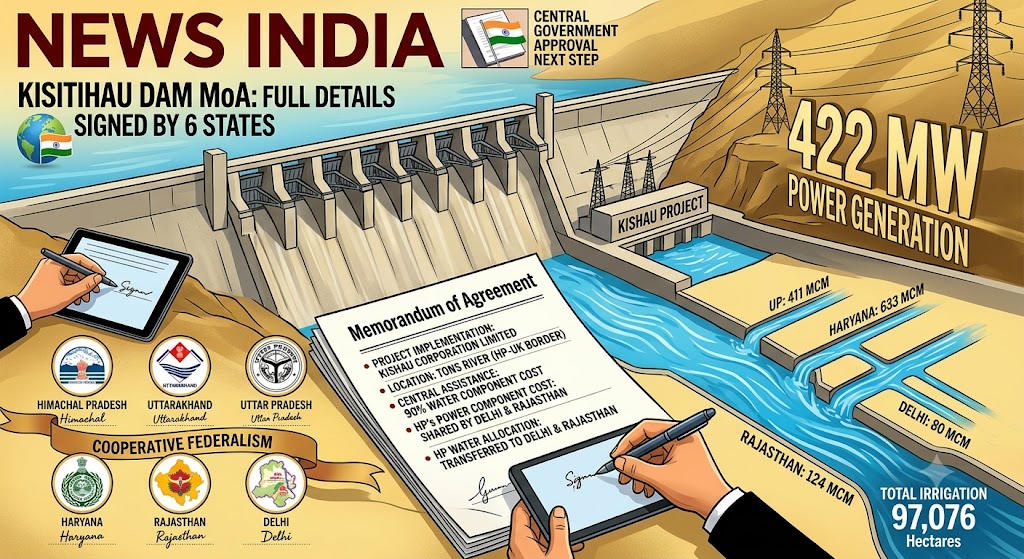
A Memorandum of Agreement (MoA) for the long-pending Kishau Multipurpose Project was signed on September 15, 2026, in New Delhi. The agreement was signed between the chief ministers of Himachal Pradesh, Uttarakhand, Uttar Pradesh, Rajasthan, Delhi and Haryana, in the presence of Union Home Minister Amit Shah and Union Jal Shakti Minister C.R. Patil. Union Home Secretary Govind Mohan and the Secretary of the Department of Water Resources, River Development and Ganga Rejuvenation were also present. Below is a full, detailed breakdown of the agreement, the project itself, and the dispute it resolves.
Who Signed the Agreement-
The MoA was signed by the chief ministers of all six participating states:
- Sukhvinder Singh Sukhu — Himachal Pradesh
- Pushkar Singh Dhami — Uttarakhand
- Yogi Adityanath — Uttar Pradesh
- Bhajanlal Sharma — Rajasthan
- Rekha Gupta — Delhi
- Nayab Singh Saini — Haryana
Amit Shah described the pact as a "historic agreement" and stated it marks the resolution of the 10th water dispute since Narendra Modi became prime minister.
Project Specifications-
- Location: The dam will be constructed on the Tons river, which flows along the border of Uttarakhand and Himachal Pradesh.
- Dam height: 232.6-metre-high concrete gravity dam.
- Storage capacity: 1,562 million cubic metres (one report separately cited a live storage capacity of 1,562 million cubic metres).
- Irrigation: Will irrigate approximately 97,000 hectares of agricultural land.
- Power generation: Will generate 1,476 million units of clean hydropower annually; the project is classified as a 422-MW Multipurpose Project.
- Estimated cost: Rs 15,624 crore, according to Chief Minister Sukhu; Amit Shah separately referenced an earlier estimate of around Rs 15,000 crore. (Older estimates from previous years had put the cost at Rs 7,200 crore in 2017 and Rs 10,500 crore around 2018-19, reflecting how the project's projected cost has risen substantially over its more-than-eight-year delay.)
Cost-Sharing Arrangement-
The financial arrangement was the central sticking point that had delayed the project for years, and the agreement lays out the following terms:
- The Centre will bear approximately 90 per cent of the overall financial burden of the project.
- The remaining 10 per cent will be borne by the six participating states, in accordance with the 1994 agreement governing water allocation in the upper Yamuna basin.
- Specifically for the water/irrigation component, 90 per cent of the cost will be covered by the central government as Central assistance, with the remaining 10 per cent shared among the six states.
- On the power component specifically, Delhi, Rajasthan and Haryana will jointly bear the estimated Rs 2,000 crore cost of the power component on the Himachal Pradesh side. This revised arrangement was the key point that removed the major point of contention and paved the way for the MoU's signing.
Union Home Minister Amit Shah stated that Uttarakhand had raised certain difficulties during negotiations, and that the Centre had assured the state that efforts would be made to accommodate its demands, including assistance in bearing whatever financial burden falls upon it.
What Himachal Pradesh Gets-
Chief Minister Sukhvinder Singh Sukhu said Himachal Pradesh is expected to earn around Rs 1,200 crore annually from the project once it becomes operational. He specified that the biggest benefit for Himachal Pradesh under the agreement is that the state will receive 211 MW of electricity generated from the Kishau Dam without having to bear the cost of generation.
Sukhu also said that the participation of both Himachal Pradesh and Uttarakhand has been ensured in the project's execution, with both states set to have equal representation — 50 per cent of the project's employees will come from each state.
Who Else Benefits-
According to Amit Shah, Delhi would be the biggest beneficiary of the project overall, given the scale of irrigation and water supply benefits the dam is expected to provide to the upper Yamuna basin states. The project is expected to boost water security for Delhi, Haryana, Uttar Pradesh, and Rajasthan, in addition to the power benefits flowing to Himachal Pradesh and Uttarakhand.
Background: Why the Project Was Delayed for Over Eight Years-
The Kishau Multipurpose Project has been under discussion and dispute for well over a decade:
- As early as 2017, the Himachal Pradesh and Uttarakhand governments had created a special purpose vehicle to execute the project, setting up a corporate office at Dakpathar in Uttarakhand, with the project cost then estimated at Rs 7,200 crore.
- In January 2018, then-Chief Minister Jai Ram Thakur sought a redraft of the agreement before signing an MoU with the other partner states, arguing that if the Centre was funding 90 per cent of the irrigation component's cost, it should also fund 90 per cent of the power component's cost, given that Himachal Pradesh and Uttarakhand are both special category Himalayan states. The signing was postponed without a fresh deadline at that time.
- By May 2018, Himachal Pradesh and Uttarakhand were still working to iron out differences ahead of a planned MoU signing, with the project cost by then estimated at Rs 10,500 crore for a proposed 660-MW capacity, and the project already cleared as a national project with 90 per cent Central funding — but the partner states still could not agree on how to share the benefits.
- Himachal Pradesh had long argued that as an upstream state bearing the direct impact of the proposed dam and reservoir, it should not be made to shoulder a disproportionate financial burden when much of the water would benefit downstream states.
- A breakthrough meeting was held on June 16, 2026, chaired by Union Home Minister Amit Shah, at which the six states reached consensus on the long-pending project and agreed to sign an MoU for its implementation.
- The MoA signed on September 15, 2026, came nearly three months after that June meeting, formalising the consensus reached at the time.
What Happens Next-
With the MoA now signed, the Kishau Multipurpose Project will be placed before the Union Cabinet for approval. Amit Shah stated that the Centre had declared the Kishau Multipurpose Project a national project following the signing of the agreement.
A Related Project: Renukaji Dam-
The Kishau project is part of a broader series of multipurpose dam agreements among the same upper Yamuna basin states under the 1994 framework, which stipulated that separate agreements would be executed for each identified storage project. One such related project is the Renukaji Multipurpose Dam, to be built on the Giri river in Uttarakhand, for which the same six states signed an MoU in an earlier year at an estimated cost of Rs 4,596 crore. The Renukaji dam is proposed to be executed by Himachal Pradesh Power Corporation Ltd (HPPCL) and is expected to generate 40 MW of power during peak flow, in addition to augmenting water availability for the same six states.
Quick Reference: Kishau Multipurpose Project at a Glance-
| Detail | Figure |
| River | Tons (Uttarakhand-Himachal Pradesh border) |
| Dam height | 232.6 metres (concrete gravity dam) |
| Storage capacity | 1,562 million cubic metres |
| Irrigation coverage | 97,000 hectares |
| Power capacity | 422 MW; generates 1,476 million units annually |
| Total estimated cost | Rs 15,624 crore |
| Cost sharing | Centre 90%, six states 10% (per 1994 agreement) |
| Power component cost | Rs 2,000 crore (Delhi, Rajasthan, Haryana jointly, on the HP side) |
| HP's annual earning | Rs 1,200 crore (from 211 MW allocation, generation cost-free) |
| Employment split | 50% HP, 50% Uttarakhand |
| Next step | Union Cabinet approval, following national project declaration |
Figures for project cost have varied across reports and over the years as the project's scope and price estimates evolved during the more-than-eight-year delay; the Rs 15,624 crore figure and the specific cost-sharing terms above reflect the agreement signed on September 15, 2026.
Login to leave a comment.